Free white paper · Remote therapeutic monitoring
The RTM rules for 2027 and your locality's rates, in one document
Medicare's remote therapeutic monitoring changed in 2026 and changes again on January 1, 2027. Tell us where your practice is, and we will send you a short white paper with the rules that apply and the 2027 amounts for your payment locality, ready to forward to a partner or your biller.
For owners of mental-health practices with clients in traditional Medicare, and for the people who do their billing.
Get your free white paper
Your work e-mail and your practice ZIP code are all we need. We prepare the paper for your Medicare payment locality and send it by e-mail.
We use your answers only to prepare and send the document and to reply.
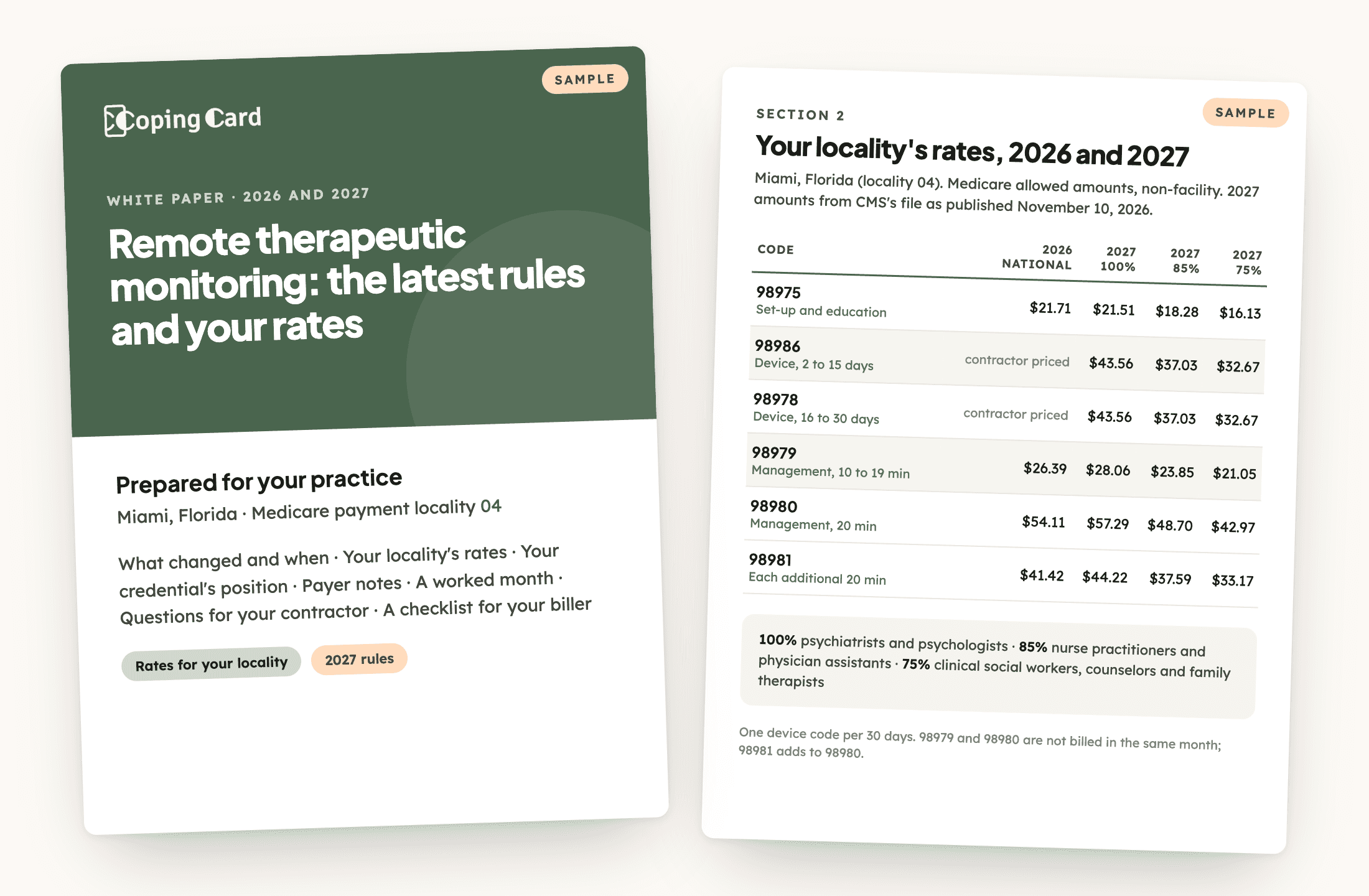
What's inside the RTM white paper
- What changed and when, 2022 to 2029, each step tied to the CMS rule.
- Your locality's rates: every RTM code for 2026 and 2027, at 100%, 85% and 75% of the fee schedule, and what Medicare pays (80%; the client's 20% coinsurance is billed as usual, and many clients have a supplemental plan that covers it).
- Your credential's position: what CMS's own text says for psychiatrists and psychologists, nurse practitioners and physician assistants, clinical social workers, counselors and marriage and family therapists.
- Payer notes: where these amounts apply, and what to ask Medicare Advantage and commercial plans.
- A worked month: the revenue RTM could add for a typical small practice, with the assumptions in view, or for yours if you tell us its size.
- Questions for your Medicare contractor.
- A one-page checklist for your biller.
Why RTM is worth a look now
For years the RTM device codes asked for 16 days of data in a month, which weekly therapy rarely meets. From 2026, a month with 2 days of data supports a device code, and 10 to 19 minutes of your management time is a code of its own.
From January 1, 2027, the CBT device codes have a national Medicare price, and RTM starts at an initiating visit for clients new to it. Clients already monitored before then do not need one.
What a practice can bill depends on where it is and who bills, so a document for your locality and your credential answers more than a general article can. For the full history and every code, read the RTM guide.
Questions about the white paper
Who is it for?
Owners of mental-health practices with clients in traditional Medicare, and the people who do their billing.
Is it free?
Yes. It is a free white paper: tell us where your practice is, and it arrives by e-mail within one business day.
What do I send?
Your work e-mail and your practice ZIP code. A second, optional step lets you add your credential and the size of your practice.
What happens next
1. You send two fields
Your work e-mail and your practice ZIP code. A second, optional step lets you add your credential and the size of your practice.
2. We prepare your paper
The rates come from CMS's 2027 file as published November 10, 2026. A person checks every figure before the paper is sent.
3. It arrives by e-mail
Within one business day, as a PDF you can forward to a partner, a colleague or your biller.
Want your numbers right now? Try the RTM calculator. Prefer to talk it through? Book a 30-minute call. Curious what the software handles? See what CopingCard does for RTM.
General information, not billing or legal advice: your biller confirms codes and eligibility with your Medicare contractor. Medicare Advantage and commercial plans set their own RTM policies. The 2027 amounts are CMS's file as published November 10, 2026 and may change before January 1.