CBT Techniques: Behavioral Experiments
A behavioral experiment is a planned test of a belief in real life. It is one of the central methods of cognitive behavioral therapy (CBT), and many clinicians consider it one of the most powerful ways to change a belief. This article explains where it comes from, what it works on, the two main kinds, how to design one, and what to do with the result. It ends with how to run experiments in CopingCard.
Where behavioral experiments sit in CBT
Behavioral experiments join the two sides of CBT. The belief comes from the cognitive model: the meaning we give to events shapes how we feel and act. The test comes from the behavioral side: we try something and observe. Aaron Beck used behavioral experiments from the start, so cognitive therapy was never only talking yourself out of a feeling. Today they are used for anxiety, depression, social anxiety, health anxiety, OCD, trauma-related problems and more.
They work with other tools. A thought record or Dysfunctional Thoughts Test often produces the prediction. An exposure is a behavioral experiment about a fear, and the expectancy questions in exposure follow the same logic. A Coping Card can hold what you learned. In acceptance-based approaches, you can run an experiment on a different question: not "is this thought true?" but "what happens if I act on what matters while the thought is there?"
Why experiments, not arguments
Many people can say, "I know it's probably not true, but it feels true." This head-heart gap is common. Arguing with a thought, even well, changes what you believe in your head. Behavioral experiments change what you know from experience, which reaches the felt belief more directly. In a study by Bennett-Levy (2003), people who practiced both written thought records and behavioral experiments rated experiments as the more powerful and compelling way to change beliefs and behavior.
There is a second mechanism. Expecting something bad leads us to avoid or protect ourselves, so the prediction is never tested, and the relief of avoiding keeps the pattern going. Doing the feared thing on purpose creates a new memory beside the old expectation, as in exposure.
An example: Maya and saying no
Maya believes, "If I say no, they'll be angry." It is a conditional assumption (if X, then Y), and it often connects to a deeper belief, such as "I'm only acceptable if I'm useful" or "I'm too much for people." The rule that follows is: "Always say yes." So she says yes to almost everything. She is tired, and the belief is never tested.
The two kinds of experiment
Hypothesis-testing experiments ask "Is it true that...?" They compare two accounts of what will happen.
- Hypothesis A (the current belief): "If I say no to a late request, my manager will be angry and it will damage our work."
- Hypothesis B (an alternative): "My manager will accept it, perhaps with mild annoyance, and our work will be fine."
Maya rates how strongly she believes each, say 80 for A and 20 for B.
Discovery experiments are for when you do not yet know what happens: "What would happen if...?" They gather information. Maya might ask three colleagues how they decide when to say no, or notice how others turn down requests at work. Discovery experiments are often used early in therapy, to build the formulation.
Experiments can also be active (you do something, in a real situation or a rehearsed one such as a role play) or observational (you watch others, ask them or look up information).
Designing a good experiment
- State the prediction clearly enough to be wrong. "My manager will be angry" is vague. "She will say she is disappointed or ask why, and the project will be affected" can be checked.
- Rate the belief (0 to 100) before, and say what would count as evidence for each account.
- Choose a small, safe test in a real situation. Start with a low-stakes request, not the hardest one.
- Plan around safety behaviors. Safety behaviors are things we do to prevent the feared outcome: over-apologizing, explaining at length, making up an excuse. If Maya apologizes for five minutes while saying no, she cannot tell whether the apology prevented the anger. So she plans to say it briefly and kindly, without the extra. Also note what is realistically helpful, such as breathing, preparing a sentence or asking a friend to know about the plan.
- Decide how you will record what happened: what you did, what the other person did, how you felt.
After the experiment
Write what actually happened, and re-rate the belief. Compare it with the prediction. Then comes the reflection step, which is easy to skip and is where much of the change happens:
- What does this mean for the belief I tested?
- What does it mean for the rule behind it ("Always say yes")?
- What would I like to try next?
Results are not always clean. If her manager is a little annoyed, the question changes from "will they be angry?" to "can I cope with a little annoyance?" That is real information, and it can be tested too. If the feared thing did happen, the useful questions are how likely it is to happen again, how bad it was, and how you coped. If the result was good, check whether it might be put down to chance ("she was in a good mood") and repeat in another setting. A single experiment rarely changes a belief held for years. Repeated in different situations, experiments build up evidence of your own.
Combining with other tools
- Thought testing: use the thought test to find the prediction, then test it by experiment.
- Exposure: a fear-based experiment with expectancy tracking.
- Behavioral activation: "I won't enjoy it" is a prediction an activity can test.
- Values: run an experiment on whether acting on what matters is possible while the thought is present.
Behavioral experiments are not suited to every belief. Some predictions are unsafe to test; some beliefs are better approached by understanding where they came from; and for deeply held beliefs, a therapist can help design stepwise tests.
What the app adds to a paper experiment
A behavioral experiment on paper works if you keep the sheet, remember the prediction and run the test more than once. The app is built to support those three things.
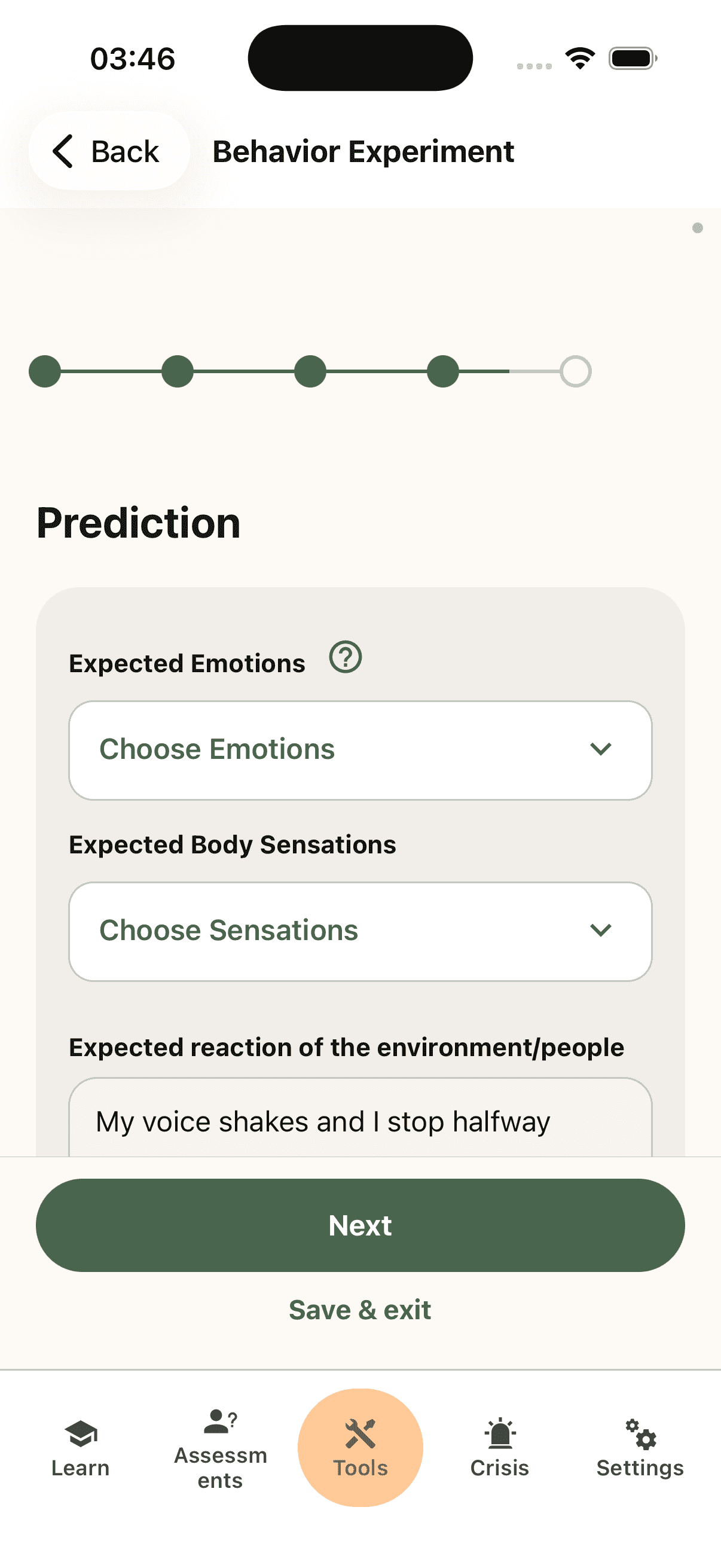
- The prediction is written down before the test. You rate how strongly you believe each account, describe what you expect, and note the emotions and body sensations you expect. After the run you record what happened, which account held, and how strongly you still believe the original thought. Comparing a stated prediction with the outcome is the point of the method (Bennett-Levy and colleagues, 2004).
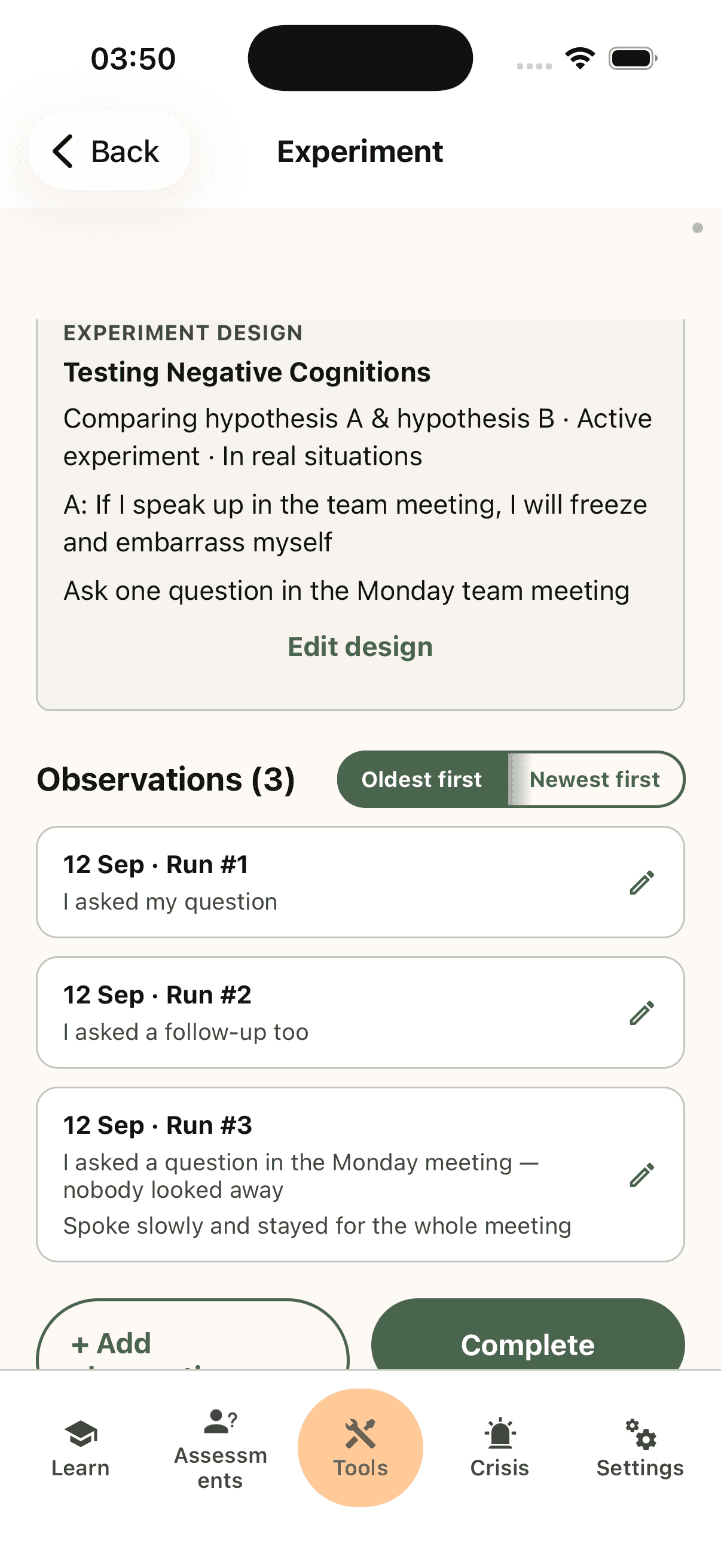
- Every run is its own record. An experiment can have as many observations as you need, and you can correct one later. The completion step shows your first prediction beside the whole run: how many observations, over how many days.
- A draft waits for you. A half-planned design stays under Drafts and reopens at the first empty step.
- Work on it with your therapist. If you share your data with your therapist, you can go through the design and every observation together. With editing allowed, they can design an experiment with you or record a run, and they can add their own reflections at the end. An experiment assigned as homework counts as done when you record an observation or complete it, so several runs show as repeats.
The case for these features comes from research: between-session practice goes with better outcomes in CBT (Kazantzis and colleagues, 2016), and repeating an experiment in different situations is how evidence builds up. Reminders come through homework: your therapist can assign an experiment with a reminder at the due time, and you can add one to your own homework, on repeat. It does not judge the result; interpreting it is the reflection step, alone or with your therapist.
Behavioral Experiment Technique in CopingCard Mobile App and Provider Platform
A behavioral experiment lives or dies on two things: a prediction stated clearly enough to be wrong, and an honest record of what actually happened — ideally more than once. CopingCard is built around exactly that shape: you design the experiment once, then you run it as many times as you need.
In the mobile app
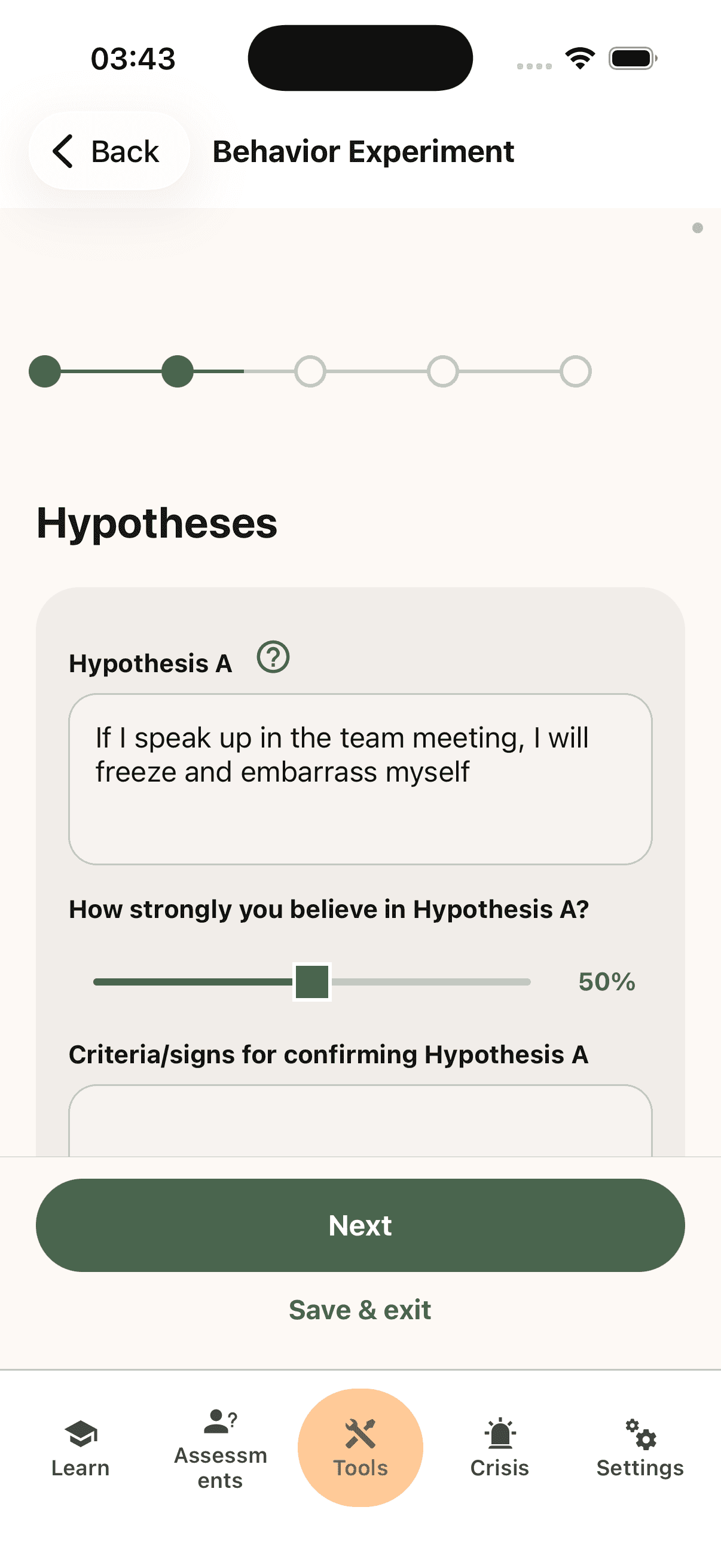
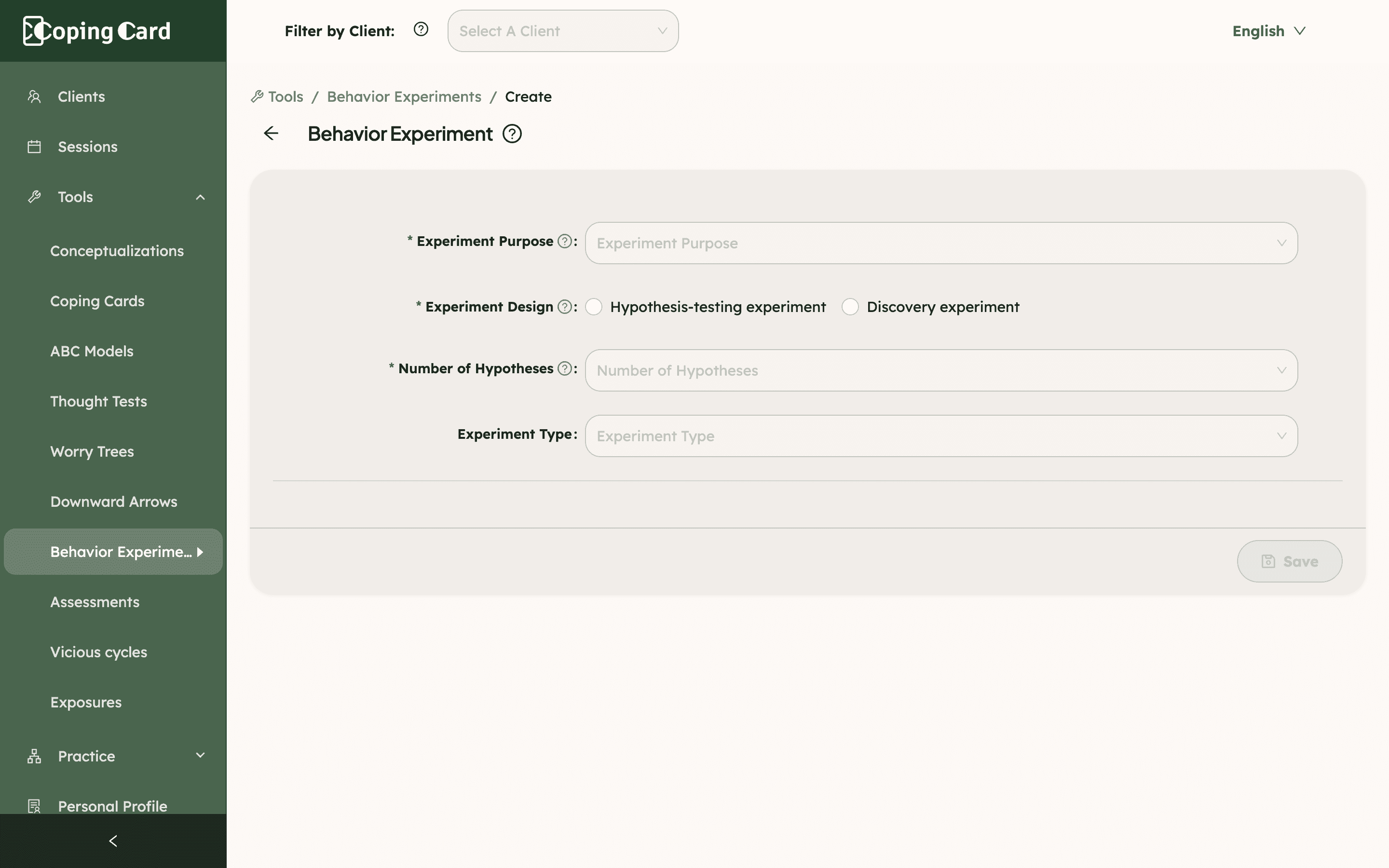
Design step by step. An experiment is planned in five short screens: Setup (its purpose, its kind and how many hypotheses), Hypotheses (the accounts you are weighing against each other, each rated by how strongly you believe it), Plan (how you will test them), Prediction (what you expect to happen, and the emotions and body sensations you expect), and Review & Activate. You can save and exit at any step, so a plan started on the bus can be completed at home. Half-planned experiments wait in Drafts and reopen at the first empty step.
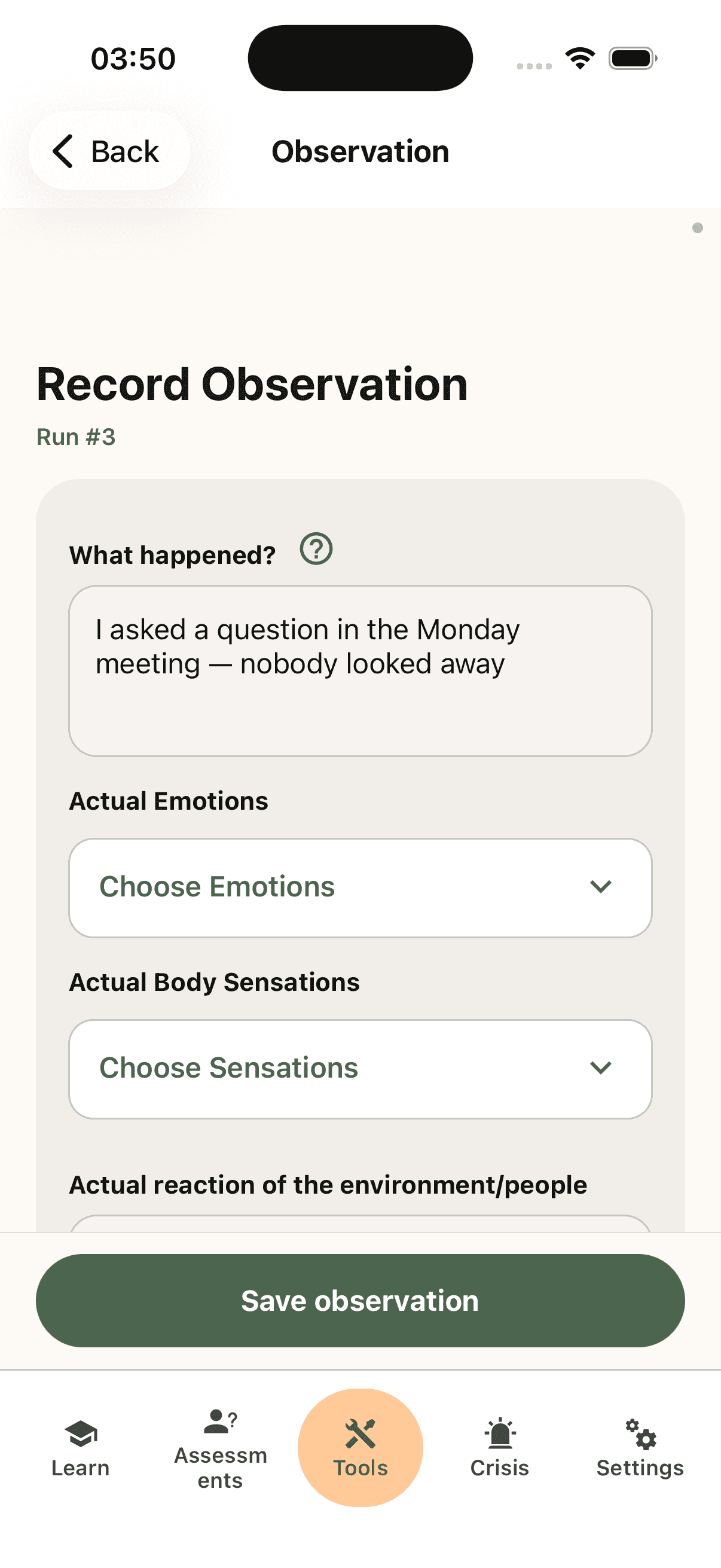
Run it, then run it again. Once the design is complete, the experiment is ready to be observed. Every time you try it, you record an observation: what happened, which hypothesis held up, your emotions and body sensations, how strongly you still believe the original thought, and what you learned. A prediction tested once is a data point; tested five times, it is evidence. If you wrote an observation in a hurry, you can go back and correct it.
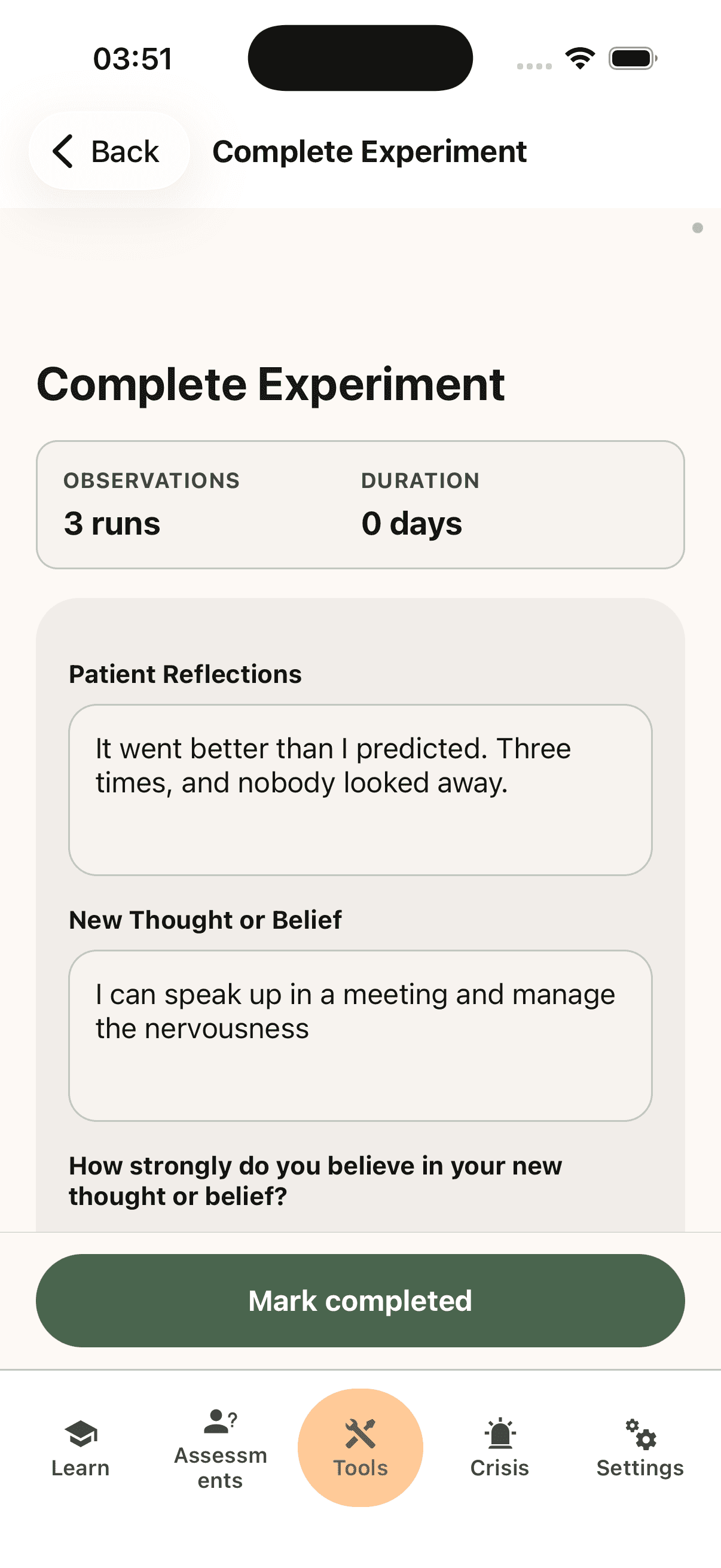
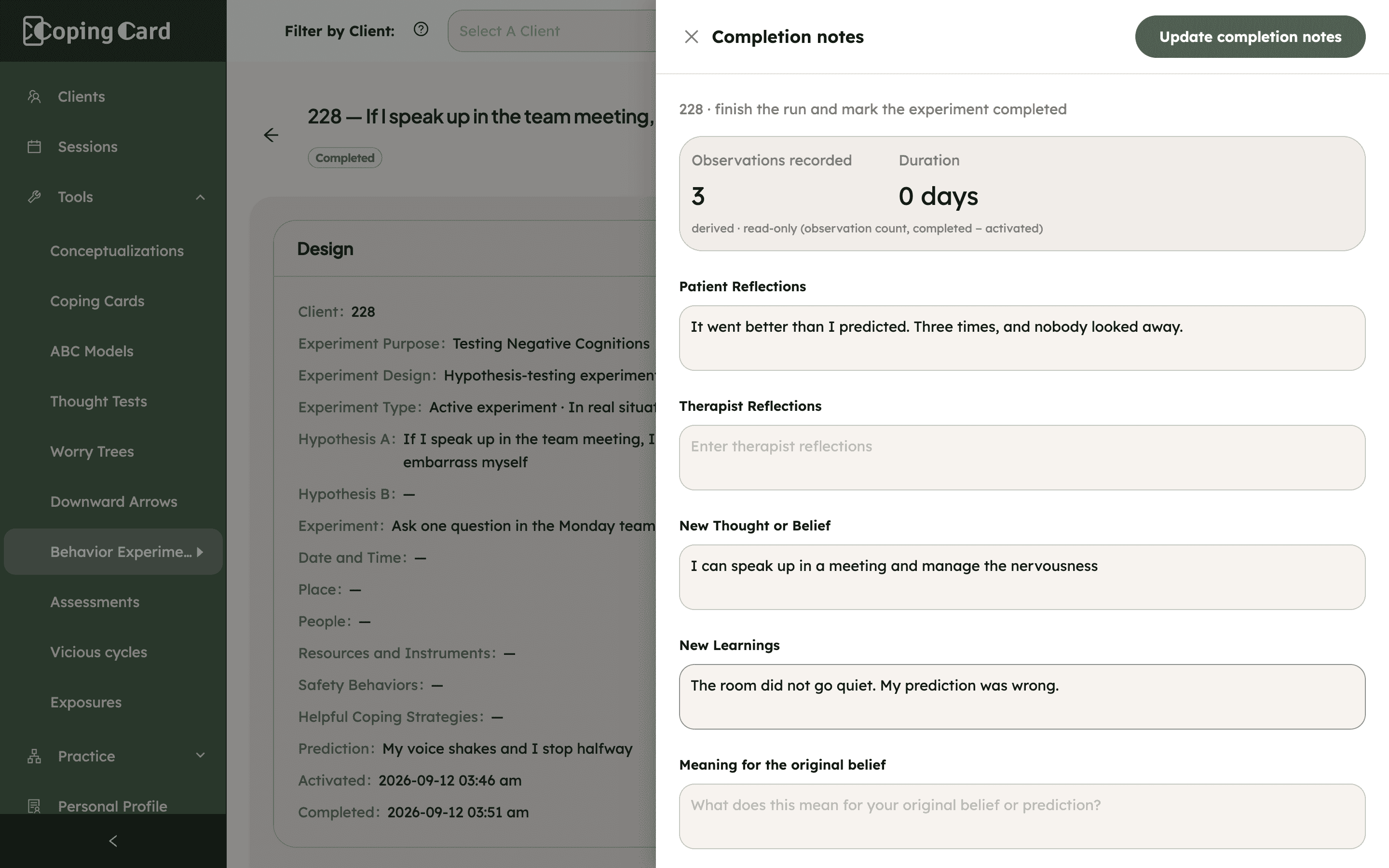
Close the loop. When you have run the experiment enough, a completion step puts your original prediction next to the whole run — how many observations, over how many days — and asks what it means for the belief you set out to test, and what you would try next.
In the provider platform
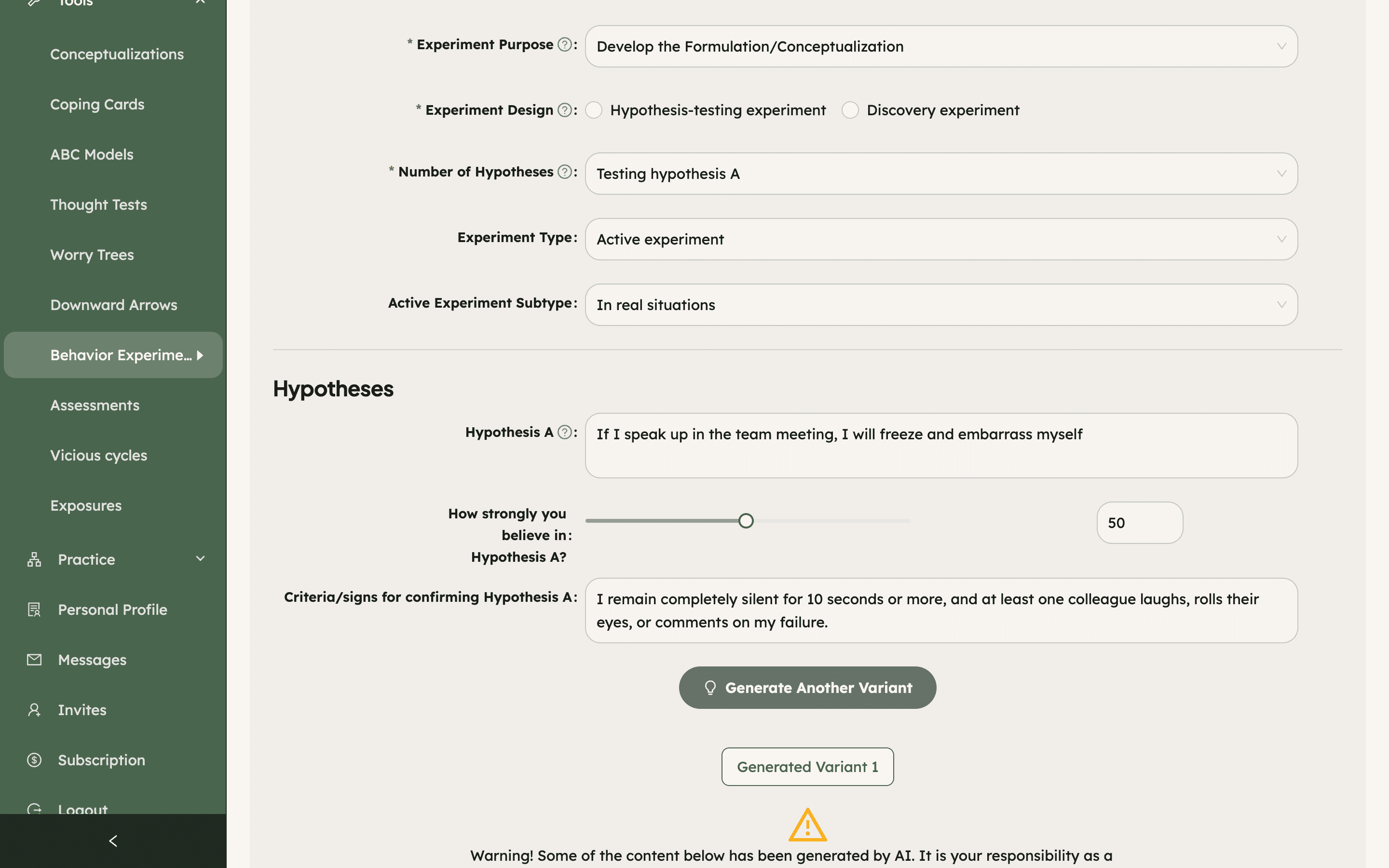
Design together in session. Therapists design an experiment for a client in the platform with the same structure — situation, hypotheses, plan, prediction — and can start from AI-generated suggestions based on a few words about the situation, then edit them into the client's own language. What you design in session appears in the client's app.
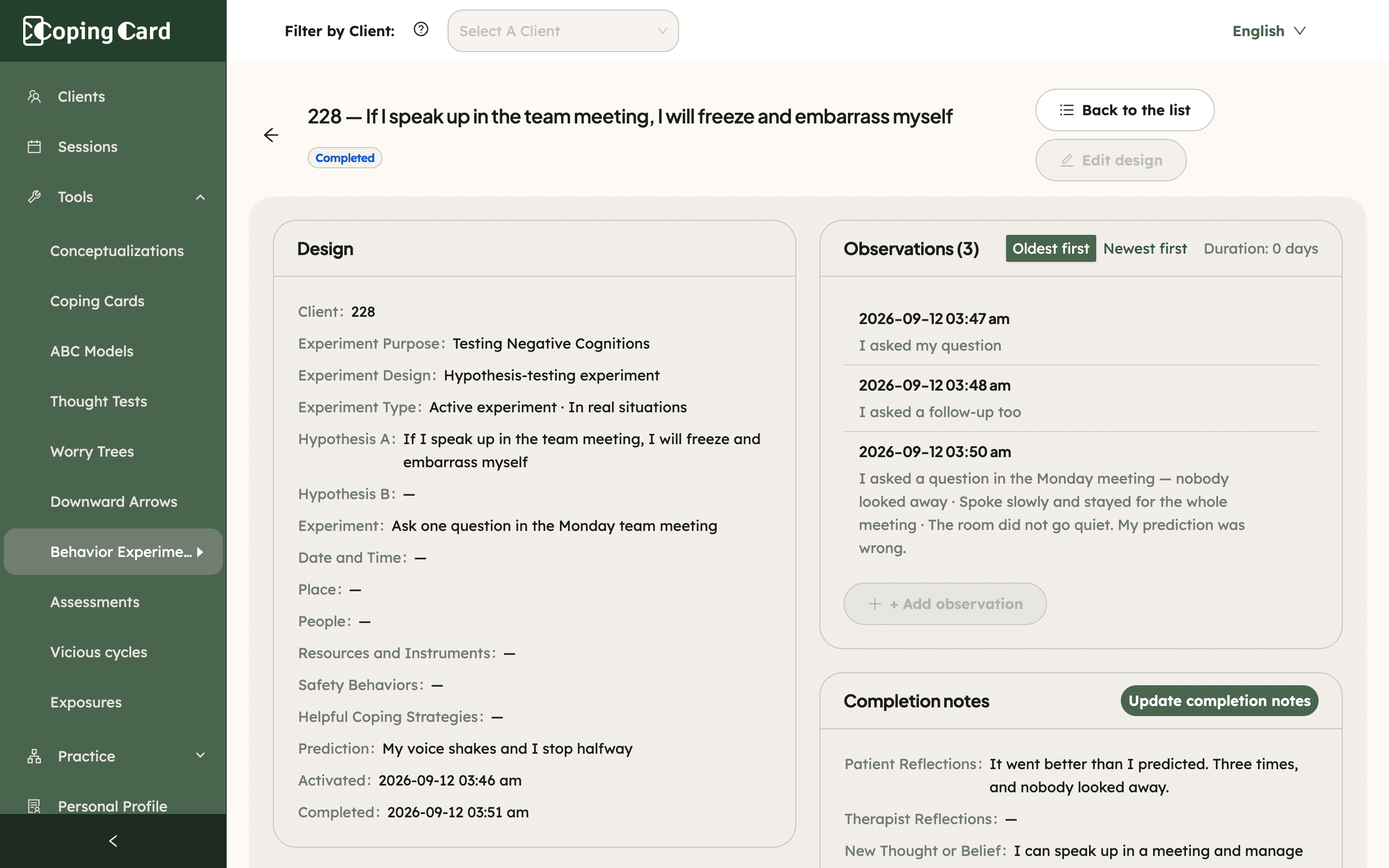
Follow the run between sessions. Observations the client records at home are in the platform when you open the experiment (CopingCard does not alert you); a therapist can also record an observation on the client's behalf, and complete the experiment together at the next session. Experiments that were designed but never activated are listed as unfinished, so nothing is lost between appointments.
One experiment, two views
The app and the platform show the same experiment. A client who shares their data with their therapist gives them the whole record — the design, every observation, the completion — rather than a recollection of it. That is what makes the technique work outside the therapy room: the between-session run is the experiment, and the session is where you make sense of it together.
Sources
- Bennett-Levy, J., Butler, G., Fennell, M., Hackmann, A., Mueller, M., & Westbrook, D. (Eds.) (2004). Oxford Guide to Behavioural Experiments in Cognitive Therapy. Oxford University Press.
- Bennett-Levy, J. (2003). Mechanisms of change in cognitive therapy: The case of automatic thought records and behavioural experiments. Behavioural and Cognitive Psychotherapy, 31(3), 261-277. https://doi.org/10.1017/S1352465803003035
- McManus, F., Van Doorn, K., & Yiend, J. (2012). Examining the effects of thought records and behavioral experiments in instigating belief change. Journal of Behavior Therapy and Experimental Psychiatry, 43(1), 540-547. https://doi.org/10.1016/j.jbtep.2011.07.003. In that controlled comparison, one session of either method improved beliefs and anxiety relative to a control condition.
- Kazantzis, N., Whittington, C., Zelencich, L., Kyrios, M., Norton, P. J., & Hofmann, S. G. (2016). Quantity and quality of homework compliance: A meta-analysis of relations with outcome in cognitive behavior therapy. Behavior Therapy, 47(5), 755-772. https://doi.org/10.1016/j.beth.2016.05.002
- Craske, M. G., et al. (2014). Maximizing exposure therapy: An inhibitory learning approach. Behaviour Research and Therapy, 58, 10-23. https://doi.org/10.1016/j.brat.2014.04.006
- Tang, N. K. Y., & Harvey, A. G. (2006). Altering misperception of sleep in insomnia: Behavioral experiment versus verbal feedback. Journal of Consulting and Clinical Psychology, 74(4), 767-776. https://psycnet.apa.org/doi/10.1037/0022-006X.74.4.767
- Clément, C., Lin, J., & Stangier, U. (2019). Efficacy of behavioral experiments in cognitive therapy for social anxiety disorder: Study protocol for a randomized controlled trial. https://www.ncbi.nlm.nih.gov/pmc/articles/PMC6921437/ (a protocol, not a result)
When to get more help
Behavioral experiments are a good self-help method for everyday beliefs. If a belief is tied to trauma, to strong fear or to thoughts of harming yourself, or if an experiment feels unsafe, work on it with a therapist. In a crisis, open the Crisis tab in the app or contact local emergency services.