Dysfunctional Thought Testing: The Thought Record, Explained and Used in CopingCard
The thought record is the best-known method in cognitive behavioral therapy (CBT). In CopingCard it is the Dysfunctional Thoughts Test. You catch the thought that arrived with a painful feeling, write it down, and examine it as a hypothesis rather than a verdict. This article explains where the method comes from, what each step is for, a worked example, when it does not fit, and how to use it in the app and with a therapist.
Where it comes from and where it fits
Aaron Beck built cognitive therapy around a simple observation. Depressed and anxious clients had a stream of quick automatic thoughts that they rarely mentioned and rarely questioned. Beck proposed that the meaning we give to events shapes how we feel and act, and that these meanings can be examined together, the way a scientist examines a claim. This stance is called collaborative empiricism. The thought record is its everyday tool. Greenberger and Padesky's Mind Over Mood made it widely known as a worksheet.
CBT is now a family of therapies, and the thought record is one member of it, not the whole. It sits next to behavioral methods, where a belief is tested in real life through a behavior experiment, and next to third-wave approaches, where the question is sometimes not "is this thought true?" but "do I have to act on it?". A good formulation, a shared map of what keeps your difficulties going, helps decide which tool fits which thought. The thought record fits best with specific thoughts about specific events, in low mood, anxiety and everyday stress.
How it works: the mechanism
Why would writing a thought down change anything? Several processes are at work.
Distance. A thought in your head is something you are inside. A thought on a page is something you can look at.
Better questions. Under strain, attention narrows to whatever fits the mood. The steps ask for what does not fit, and for other explanations, so the narrow view widens.
A measurable belief. Rating belief from 0 to 100 percent turns "true or false" into a line. A drop from 80 to 50 is a real change.
Cognitive change as a route to feeling better. In cognitive therapy for depression, change in thinking is linked to symptom change. Bennett-Levy's study of therapists using the techniques on themselves suggests that thought records work through logical examination of evidence, while behavior experiments work through direct experience. The two complement each other.
The twelve steps, with a worked example
Maya's manager sends one line: "Can we talk tomorrow?" Maya thinks, "My manager is unhappy with me," and believes it 80 percent. The Dysfunctional Thoughts Test walks her through twelve short steps, and each saves as she answers it.
- Event. What happened. A one-line message from her manager.
- Emotions. What she felt, and how strongly. Anxiety, 70 out of 100.
- Sensations. Where she felt it in her body. A tight stomach.
- Behavior. What she did. Replayed the last meeting; stopped working.
- Automatic thought. "My manager is unhappy with me," with a belief rating of 80 percent.
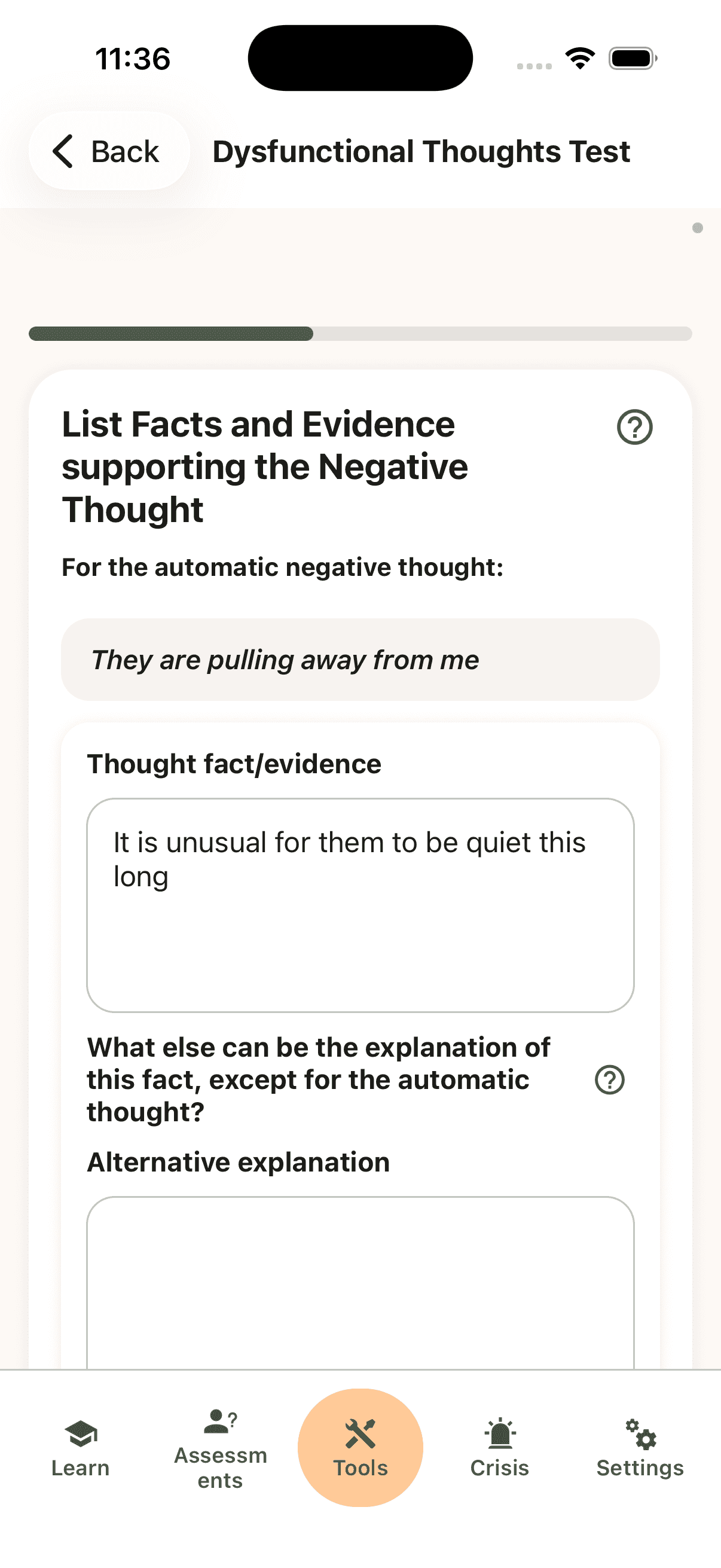
- Evidence for. What genuinely supports it. The message was short. A report went in late last week. The app also asks for a possible alternative explanation of the evidence: the message was short because her manager writes that way.
- Evidence against. What does not fit. Her manager is often brief, and her last review was good.
- Cognitive distortions. Habits of a mind under strain that may be at work: here, mind reading and fortune-telling, and catastrophizing. (See the article on thinking traps.)
- Realistic thoughts. A balanced conclusion with its own rating. "They may want to talk about the late report. That is a real issue, and I can ask what they need." Belief: 65 percent.
- Result. How the original belief and the main emotion have moved. Her belief in the first thought drops from 80 to 35 percent, and her anxiety from 70 to 45. Not to zero. Part of the thought may be true, and the next move is practical.
- Time reminders. When the new coping card should reach her.
- Location reminders. Where it should reach her, such as the office.
A short summary of the test follows the last step.
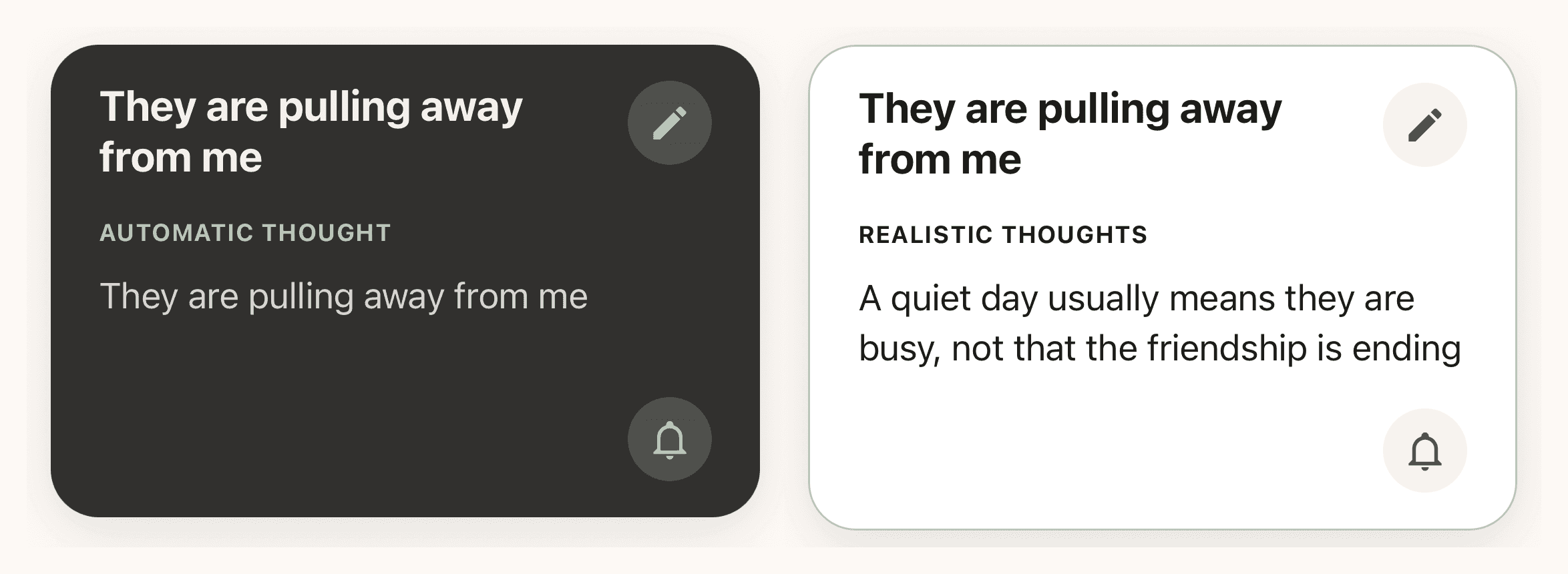
When she finishes, the app creates a coping card automatically: the automatic thought on one side, the realistic thought on the other.
Widening the view
Evidence for and against is the core, but a skilled therapist asks more, and you can too.
- What else could explain it? List at least two other explanations, even if you do not believe them.
- Decatastrophizing. What is the worst that could happen, the best, and the most likely? How would I cope with the worst? Often the feared outcome is survivable, and you have coped with something similar.
- A friend's view. What would I say to a friend who had this thought?
- Is the thought useful? Even if it cannot be settled either way, does believing it and acting on it help me?
The head-heart gap
You can know a thought is probably not true and still feel that it is. This is normal, not a failure of the method. A thought record works on the logical route. A feeling is often held by the experiential route, and experience changes it best. This is why CBT pairs thought records with behavior experiments: if Maya believes "if I ask what they need, they will be annoyed", she can ask and see. The two work together.
When the thought record fits less well
- Rumination, chronic worry and obsessions. Going over a thought again and again, or checking a thought, can become another loop. In obsessive-compulsive disorder, arguing with the content can turn into reassurance. Methods like exposure with response prevention, metacognitive therapy or defusion are usually chosen.
- Thoughts that are true. If the report really was late, the question is not "is this thought wrong?" but "what do I do now?". That is problem solving or acceptance.
- Strong distress, trauma, or thoughts of harming yourself. These need a therapist, not a worksheet.
- When you are too overwhelmed to write. Wait. Ground yourself first, and come back when you can look at it.
A thought test is also not a way to talk yourself out of every feeling. Some feelings are information. The aim is accuracy and workable thinking, not cheerfulness.
Between sessions: why it matters
Both the amount and the quality of practice between sessions predict outcome in CBT, with medium-to-large effects at the end of treatment and at follow-up (Kazantzis and colleagues). A thought record you can open on your phone when the thought arrives is practice that actually gets done.
Dysfunctional Thoughts Test in the CopingCard Mobile App
The mobile app is built around the fact that thoughts do not wait for a convenient moment.
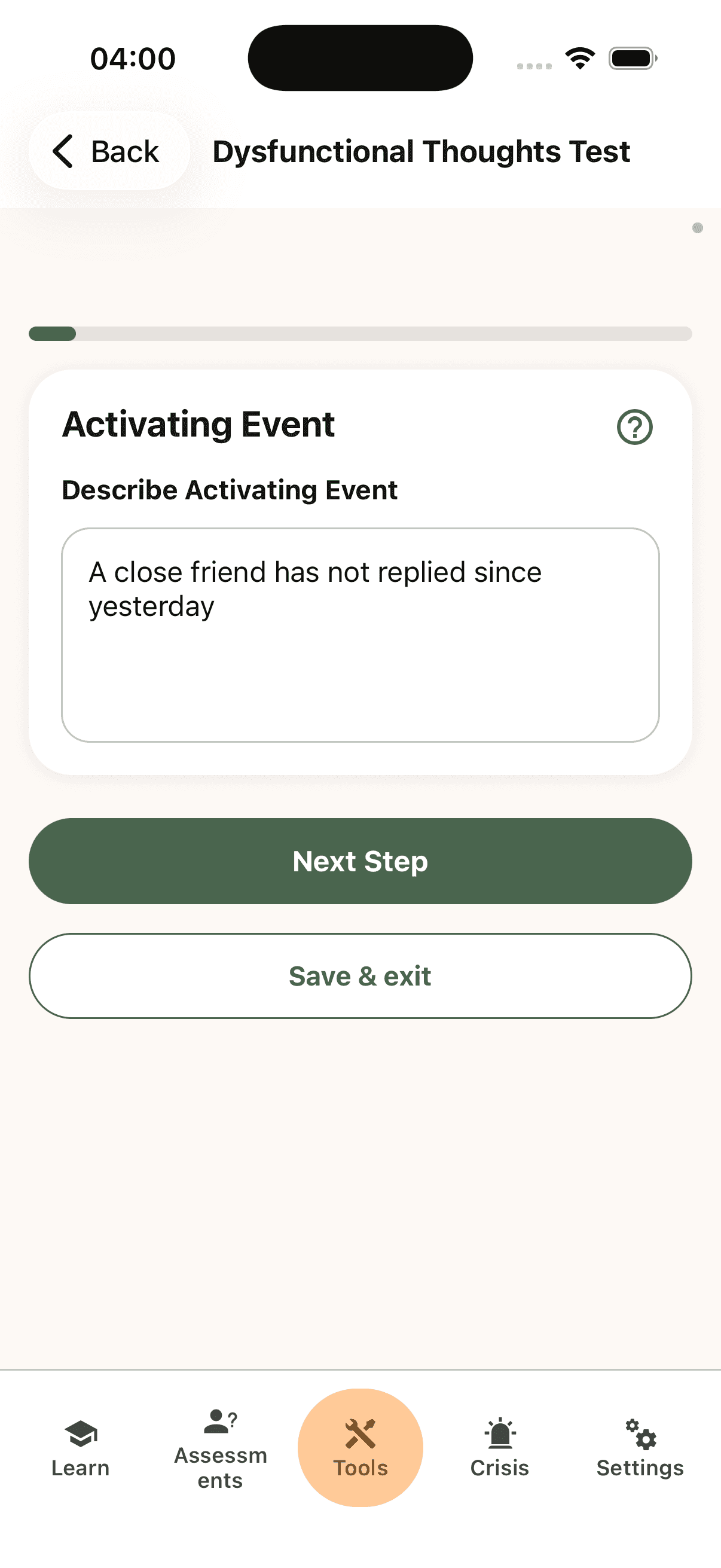
- Start anywhere, stop anywhere. Every step saves as you answer it. Get interrupted at the evidence step, and nothing is lost.
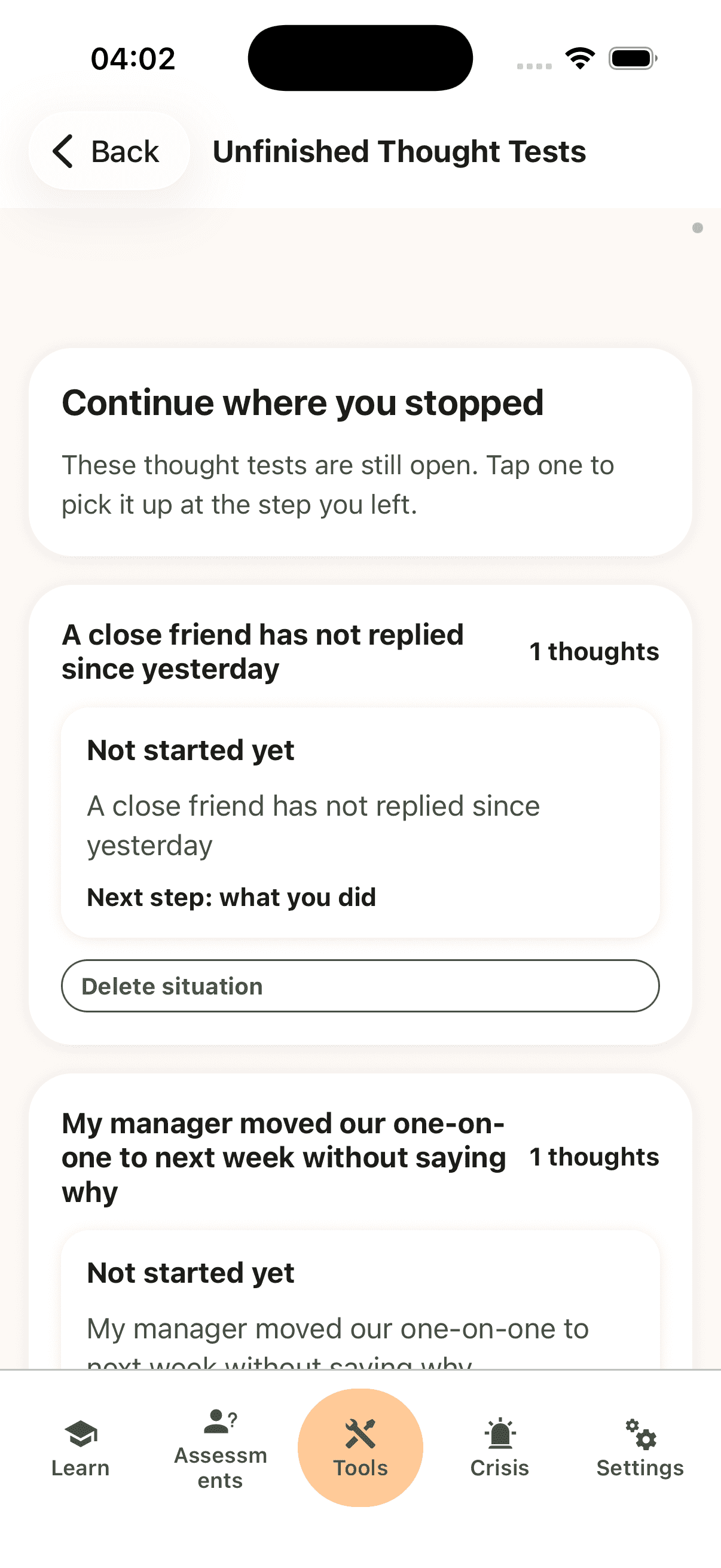
- Continue where you stopped. Unfinished tests are grouped by situation, showing the automatic thought and the next step to answer. Tap one and the test reopens at exactly that step. A situation you described but never carried into a thought is kept as a draft, not discarded.
- Change your mind later. Any step of a completed test can be edited; the record keeps your latest answer.
- Finish with a coping card. The realistic thought becomes a card you can attach reminders to, so it resurfaces when and where it is needed.
Rehearse it when — and where — it matters
A thought test is not finished when the realistic thought is written down. The automatic thought was learned through repetition, and the new one has to be learned the same way. Coping cards are meant to be re-read regularly, often two or three times a day at first; the difference a phone makes is that the re-reading can be scheduled, and it can be triggered by the situation itself.
The last steps of the wizard set that up:
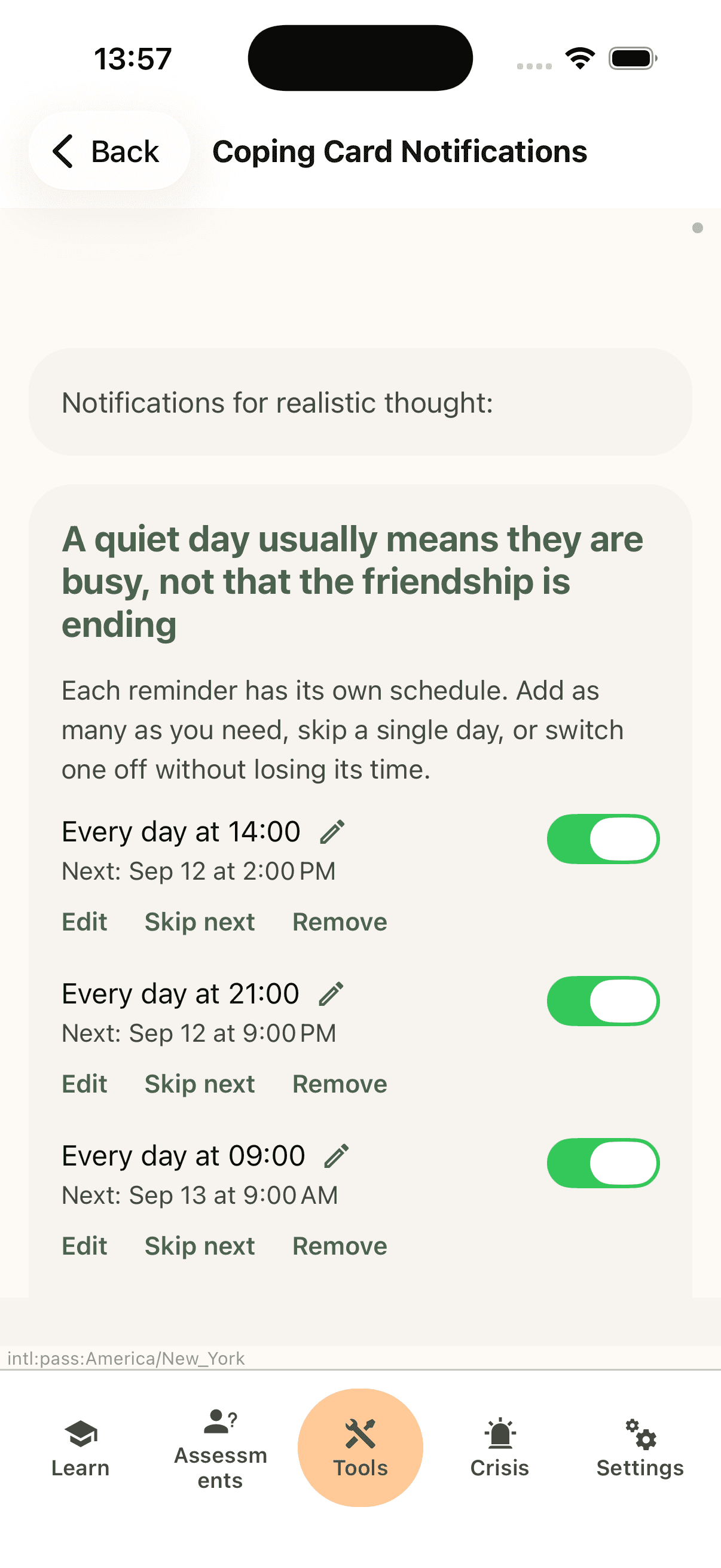
- Time-based reminders. Attach a schedule to the new coping card — three times a day at first, if that is what it takes, then spaced out as the realistic thought starts to feel natural. Each reminder has its own schedule; you can add several, skip a single day, or switch one off without losing its time.
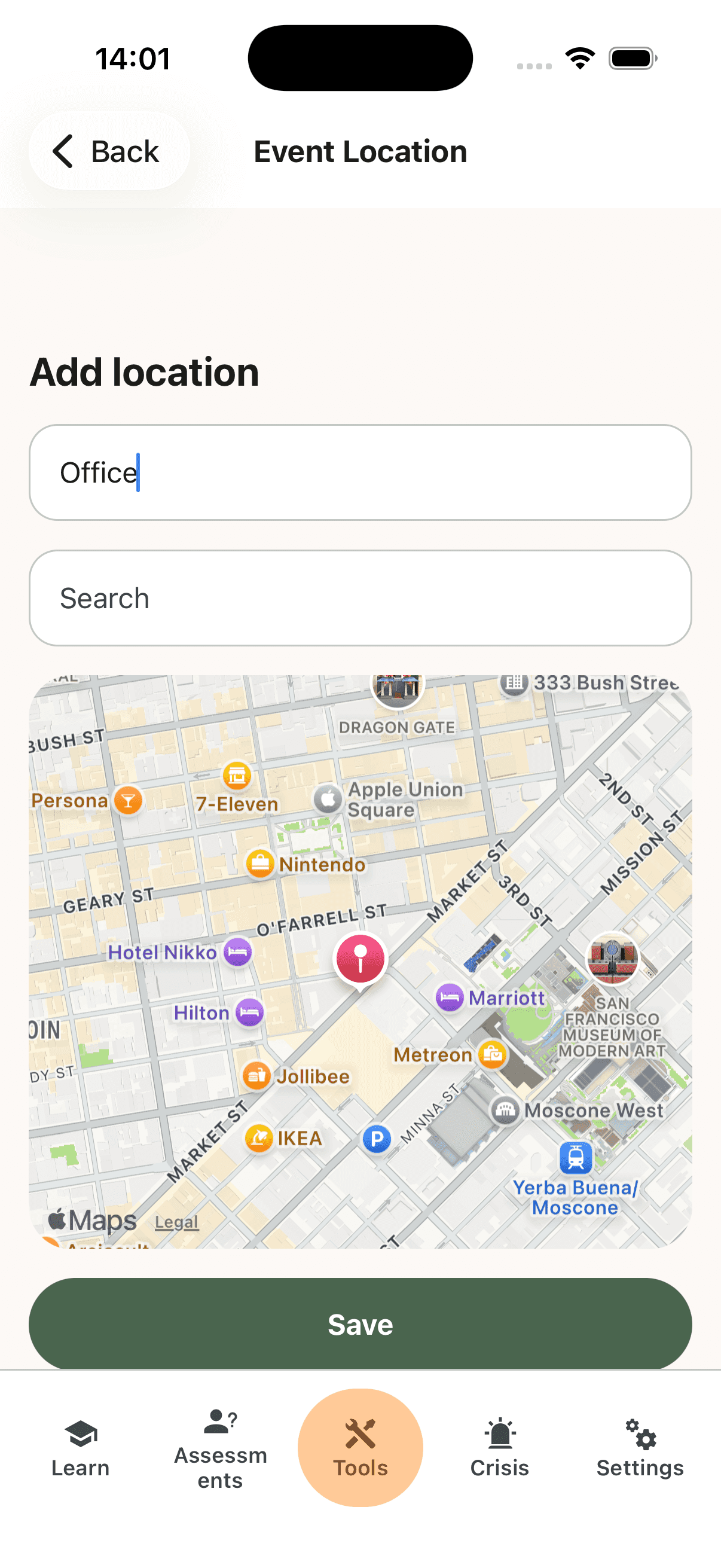
- Geolocation notifications. Attach the card to a place — the office, a relative's house, the route you dread — and it surfaces when you arrive there. There is no more timely rehearsal than the one that happens in the situation the thought belongs to.
The research on rehearsal points the same way, with one caution that comes first below. Cepeda and colleagues' meta-analysis of 317 experiments found that spacing practice out beats massing it, and that the best gap grows as you want the memory to last longer — which is exactly the "often at first, then less often" schedule. Gollwitzer and Sheeran's meta-analysis of implementation intentions — plans of the form "when situation X arises, I will do Y" — found a medium-to-large effect on goal attainment, because tying an intended response to a concrete cue hands the initiative to the situation rather than to willpower; a geofenced coping card is that plan, automated. And Fry and Neff's systematic review of periodic prompts in health behavior programs (weight, activity and diet) found that most studies reported a benefit, more so when prompts were frequent and combined with personal contact. Those studies were not about mental health, so treat this as support for the idea, not proof.
A caution. Rehearsal means reading the card to act on it. If you notice that you read it to make a feeling stop or to feel certain, especially with obsessions or health worries, it can become a reassurance ritual that keeps the worry going. Bring that to your therapist.
Dysfunctional Thoughts Test in the CopingCard Provider Platform
Therapists get the same tool in the provider platform — and the point is not that the form is the same, but what having it on both sides lets a therapist do.
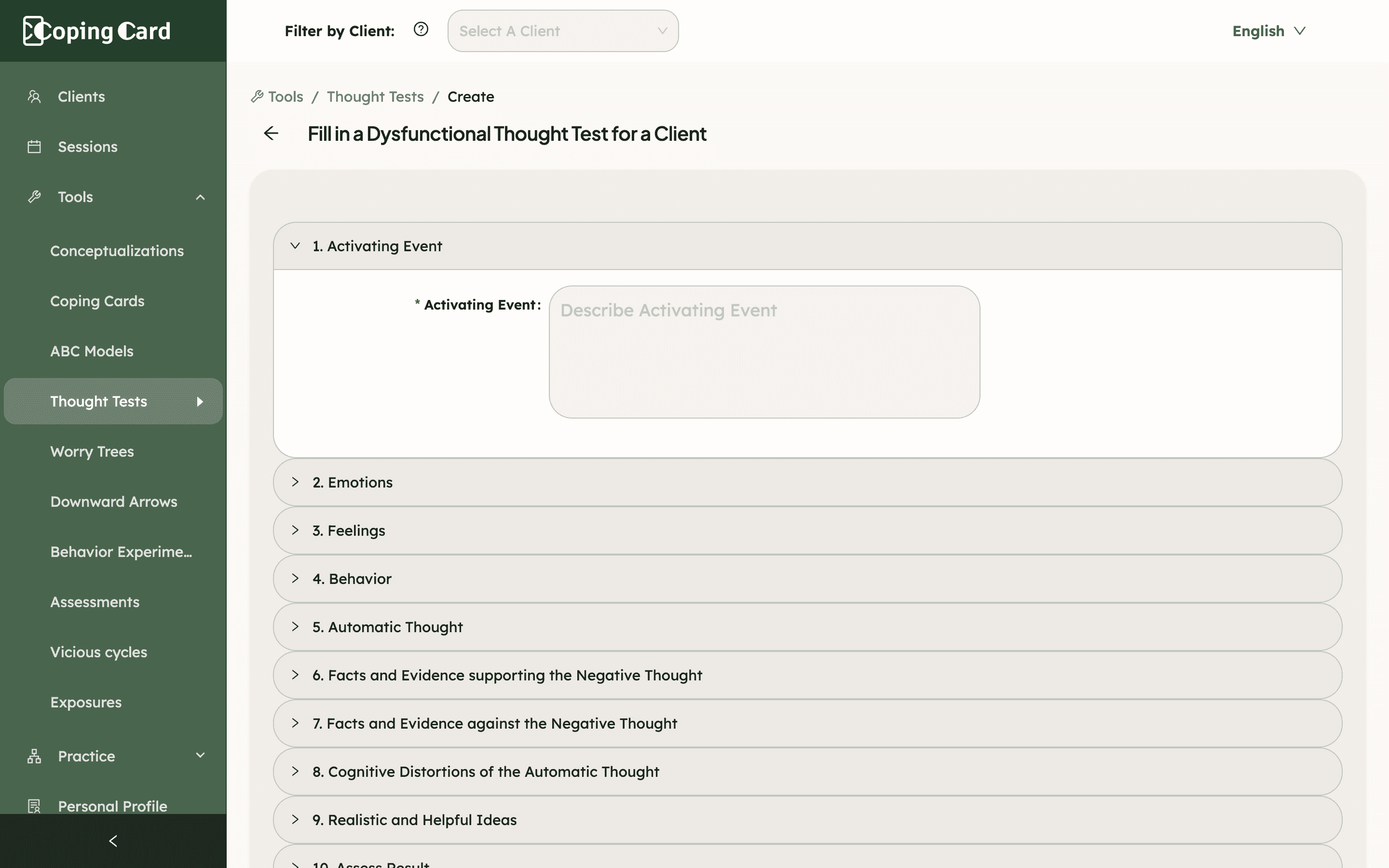
- Teach the technique by doing it. Walk a client through the steps in session, on the platform, with their own situation and their own thought — and end with a coping card that goes straight to their phone. A client who has completed one test with you knows what the tool is for.
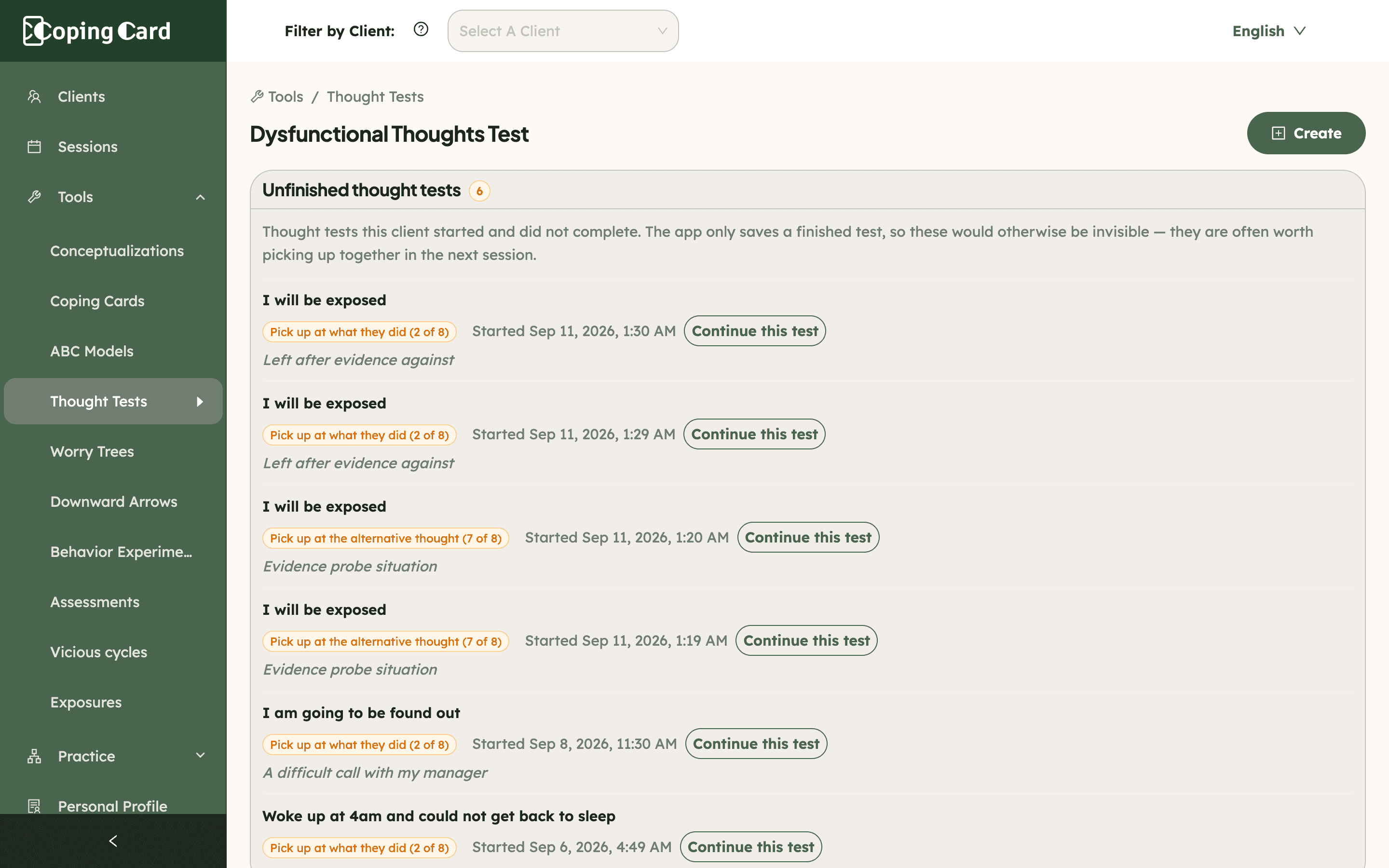
- Finish what they started. Clients get stuck: the evidence step is hard, cognitive distortions are unfamiliar, life interrupts. The platform lists each client's unfinished tests and the step they stopped at, so a session can pick up exactly there instead of starting over.
- See who is actually using the tools. A test completed on Tuesday evening is visible on Wednesday morning. Engagement between sessions stops being a matter of asking "did you try it?" — it is on the screen, test by test.
- Prepare the next session from the record, not from memory. The event, the automatic thought, the evidence, the distortions, the realistic conclusion, how the belief moved, and which coping cards the client is being reminded of — all of it is there before the session begins.
How the app and the platform work together
The Dysfunctional Thoughts Test is one record with two doors. A client shares their coping cards and thought test data securely with their provider from the app, and from then on both sides see the same thing: a test the client completes at home is what the therapist opens before the next session, and a test the therapist creates in session arrives in the client's app with its coping card and reminders attached. Nothing is retyped, nothing is summarized from memory. The therapist's between-session view — which tests were done, which were left part-way, how beliefs shifted, which reminders are set — is the evidence base for the next conversation; the client's phone is where the work actually happens.
Video
Sources
- Beck, A. T., Rush, A. J., Shaw, B. F., & Emery, G. (1979). Cognitive Therapy of Depression. Guilford Press.
- Beck, J. S. (2021). Cognitive Behavior Therapy: Basics and Beyond (3rd ed.). Guilford Press.
- Greenberger, D., & Padesky, C. A. (2015). Mind Over Mood (2nd ed.). Guilford Press.
- Bennett-Levy, J. (2003). Mechanisms of change in cognitive therapy: The case of automatic thought records and behavioural experiments. Behavioural and Cognitive Psychotherapy, 31(3), 261-277. https://doi.org/10.1017/S1352465803003035
- Lorenzo-Luaces, L., German, R. E., & DeRubeis, R. J. (2015). It's complicated: The relation between cognitive change procedures, cognitive change, and symptom change in cognitive therapy for depression. Clinical Psychology Review, 41, 3-15. https://doi.org/10.1016/j.cpr.2014.12.003
- Kazantzis, N., Whittington, C., Zelencich, L., Kyrios, M., Norton, P. J., & Hofmann, S. G. (2016). Quantity and quality of homework compliance: A meta-analysis of relations with outcome in cognitive behavior therapy. Behavior Therapy, 47(5), 755-772. https://doi.org/10.1016/j.beth.2016.05.002
- Hofmann, S. G., Asnaani, A., Vonk, I. J. J., Sawyer, A. T., & Fang, A. (2012). The efficacy of cognitive behavioral therapy: A review of meta-analyses. Cognitive Therapy and Research, 36(5), 427-440. https://pmc.ncbi.nlm.nih.gov/articles/PMC3584580/
- Salkovskis, P. M. (1999). Understanding and treating obsessive-compulsive disorder. Behaviour Research and Therapy, 37(Suppl. 1), S29-S52.
- Wells, A. (2009). Metacognitive Therapy for Anxiety and Depression. Guilford Press.
- Cepeda, N. J., Pashler, H., Vul, E., Wixted, J. T., & Rohrer, D. (2006). Distributed practice in verbal recall tasks: A review and quantitative synthesis. Psychological Bulletin, 132(3), 354-380. https://doi.org/10.1037/0033-2909.132.3.354
- Gollwitzer, P. M., & Sheeran, P. (2006). Implementation intentions and goal achievement: A meta-analysis of effects and processes. Advances in Experimental Social Psychology, 38, 69-119. https://doi.org/10.1016/S0065-2601(06)38002-1
- Fry, J. P., & Neff, R. A. (2009). Periodic prompts and reminders in health promotion and health behavior interventions: Systematic review. Journal of Medical Internet Research, 11(2), e16. https://doi.org/10.2196/jmir.1138
If you have a severe mental disorder, we recommend working through thought tests together with your cognitive-behavioral therapist.