Low Mood and Behavioral Activation: What It Is and Why It Works
When your mood is low, everything costs more: getting up, answering a message, going to the thing you used to enjoy. So you do less. That is a very human response and it is not laziness or weakness. But it has a side effect that most people do not see coming, and understanding it is the first step to changing it.
Behavioral activation (BA) is one of the best-supported psychological treatments for depression. It is also easy to misread as "do more things". This article explains what BA actually works on: the function of what you do, and the way avoidance quietly shrinks a life.
Where BA comes from in the CBT family
BA is a behavioral method, and the oldest thread in CBT. In the 1970s Peter Lewinsohn proposed that depression follows a loss of response-contingent positive reinforcement: fewer of your actions are followed by rewards. In the 1990s a research group led by Neil Jacobson tested whether the behavioral part of cognitive therapy was enough by itself and found it was surprisingly effective. Christopher Martell and colleagues turned that into the contextual form of BA used today, and Carl Lejuez and colleagues developed a brief, structured version (BATD-R).
BA sits beside cognitive therapy, not against it. Cognitive therapy works on meaning and belief; BA works on what you do and what it does for you. Some therapists use one, some the other, and many combine them. Newer process-based CBT uses BA to target a specific process: avoidance and withdrawal.
The loop
Low mood leads to doing less. Doing less means fewer things that give pleasure, achievement or closeness. With fewer rewards, mood drops further, and lower mood makes everything harder.
Many people respond by waiting: "I'll get back to it when I feel better." The trouble is that waiting is part of the loop. If feeling like it has to come first, it may not come.
What BA actually asks: functional analysis
BA does not ask "why can't you make yourself do it?". It asks a different question: what does this behavior do for you? This is called a functional analysis. The same behavior can have different functions for different people, so the answer comes from the person's own life.
An example: Sam and the football boots
Sam's winter has been quiet. His football boots stand by the front door. In the evenings he goes to the sofa and the phone. He tells himself he will go back to football when he feels more like it.
The functional question: what does the sofa do for him? When he looks closely, he finds that the group chat message ("Thursday, are you in?") brings a heavy feeling and the thought "I can't face it." Staying in takes the feeling away within minutes. That relief is a reward, and rewards make behavior repeat.
BA gives this pattern a name: TRAP.
- Trigger: the message from the football group.
- Response: the heavy feeling, "I can't face it."
- Avoidance Pattern: not replying, staying in, scrolling.
TRAP explains something that "do more" advice cannot: why the pull to avoid is so strong. Avoidance pays off immediately and costs later. The thing avoided does not go away, and often grows, and Sam's life narrows to what feels safe.
The change is TRAC: the same Trigger and the same Response, but an Alternative Coping step in place of the avoidance. Sam replies "Thursday, maybe, I'll let you know." Or he puts on the boots and goes for twenty minutes. The step does not need to be brave. It needs to be small enough to do and aimed at something that matters to him.
Two kinds of reward are at work. The relief that follows avoidance is negative reinforcement: it rewards escaping, so escaping repeats. What BA aims to restore is what Lewinsohn called response-contingent positive reinforcement: rewards that follow your own actions, such as the contact, the fresh air, the sense of having done something. With TRAC, reward starts to follow the activity instead of the avoidance.
Rumination as avoidance
A second form of avoidance is easy to miss: rumination. Going over "Why am I like this? What's wrong with me?" feels like effort and looks like working on the problem. But when it takes the place of a concrete step, it works as avoidance. It is mental activity that keeps you away from doing. In BA, rumination is treated as a behavior with a function, and the question becomes: what would be one concrete step, and what is the rumination keeping me from? (For more on rumination, see the worry article and the Vicious Cycles article.)
Life events and context
BA does not claim that low mood is only in your head. Losses, job loss, isolation, caring for someone, illness and money worries all reduce what life offers. Martell's approach is called "contextual" for this reason. Some of Sam's winter comes from the dark months and from losing touch with the team. Activation works alongside real circumstances, not instead of them, and sometimes the right step is practical: asking for help, or tackling a problem that is draining his days. If your circumstances are the main issue, say so to your therapist; it is part of the formulation.
How BA works in practice
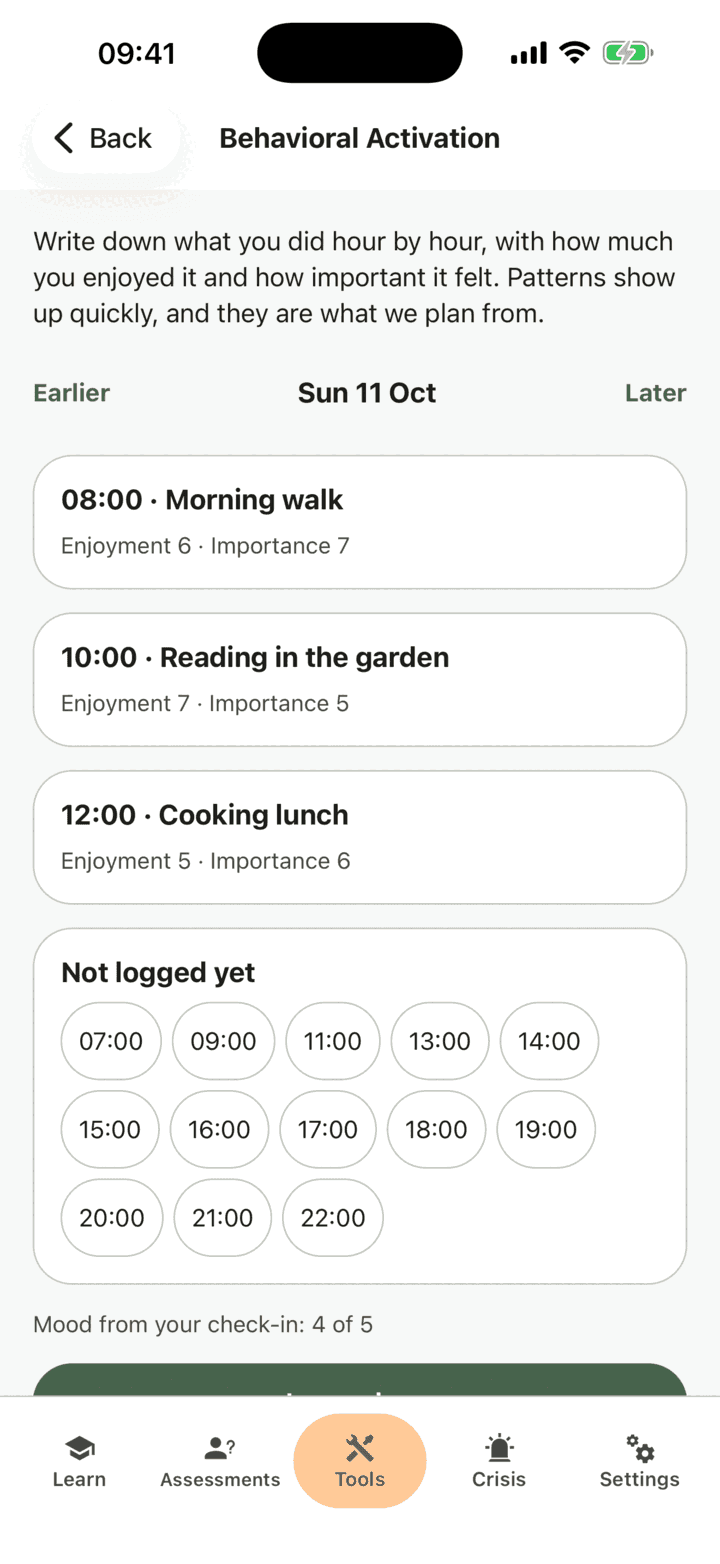
1. Monitor. For a few days, write down what you do hour by hour and rate each from 0 to 10 for Enjoyment and for Importance. Low mood is a poor forecaster, so small lifts are easy to miss until you write them down. You may also see a pattern: which parts of the day are empty, and which activities lead to a better or worse evening.
2. Connect with what matters. List what you used to do, would like to do and need to do, across areas such as relationships, education and work, recreation, mind and body, and daily responsibilities. Choose activities that connect to what you value, not only to duties. A life can be full of tasks and still feel empty.
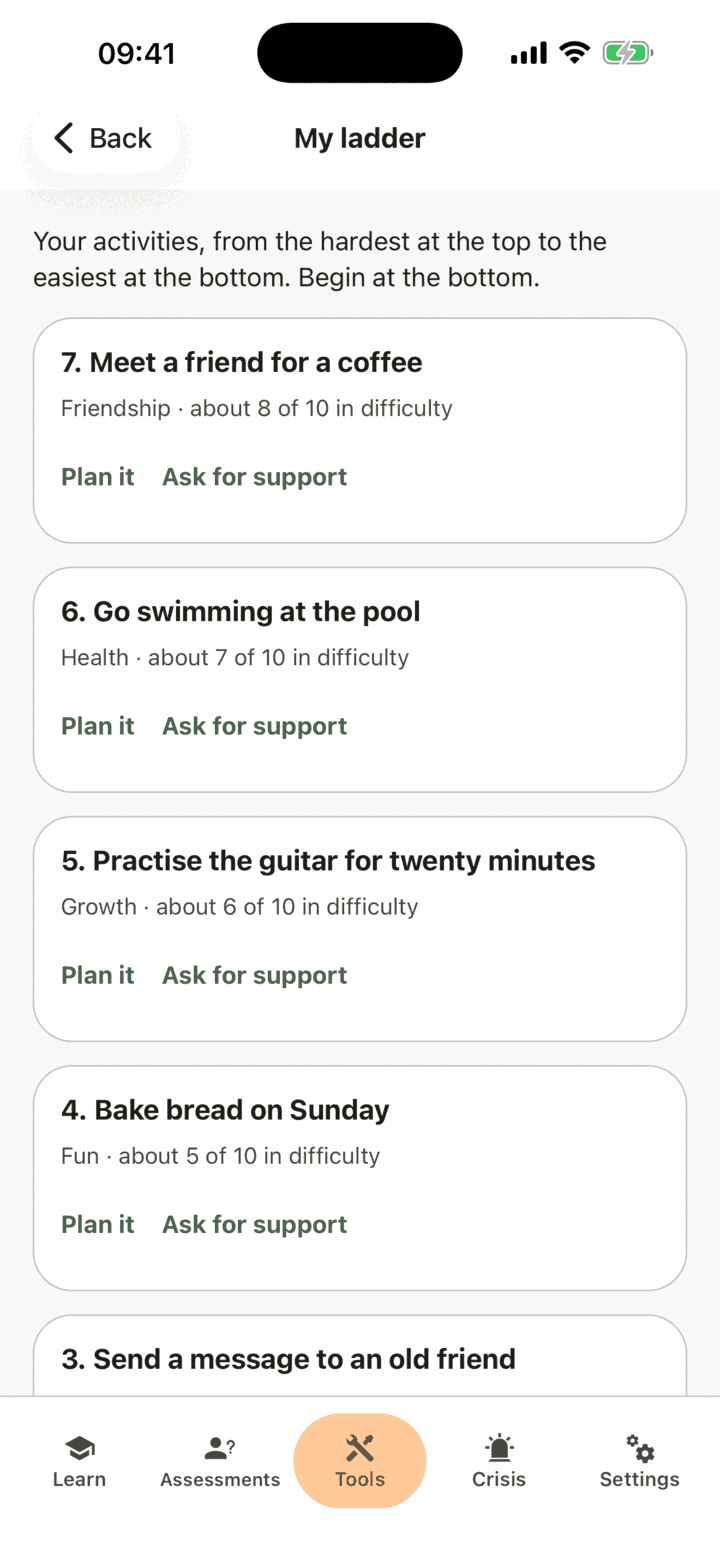
3. Start small and make it specific. "Walk more" becomes "Tuesday after breakfast, ten minutes around the block." Tying the step to something already in your routine makes it more likely to happen. Begin with the easier items. In brief BA protocols, the ranked list (a ladder) lets you build up gradually.
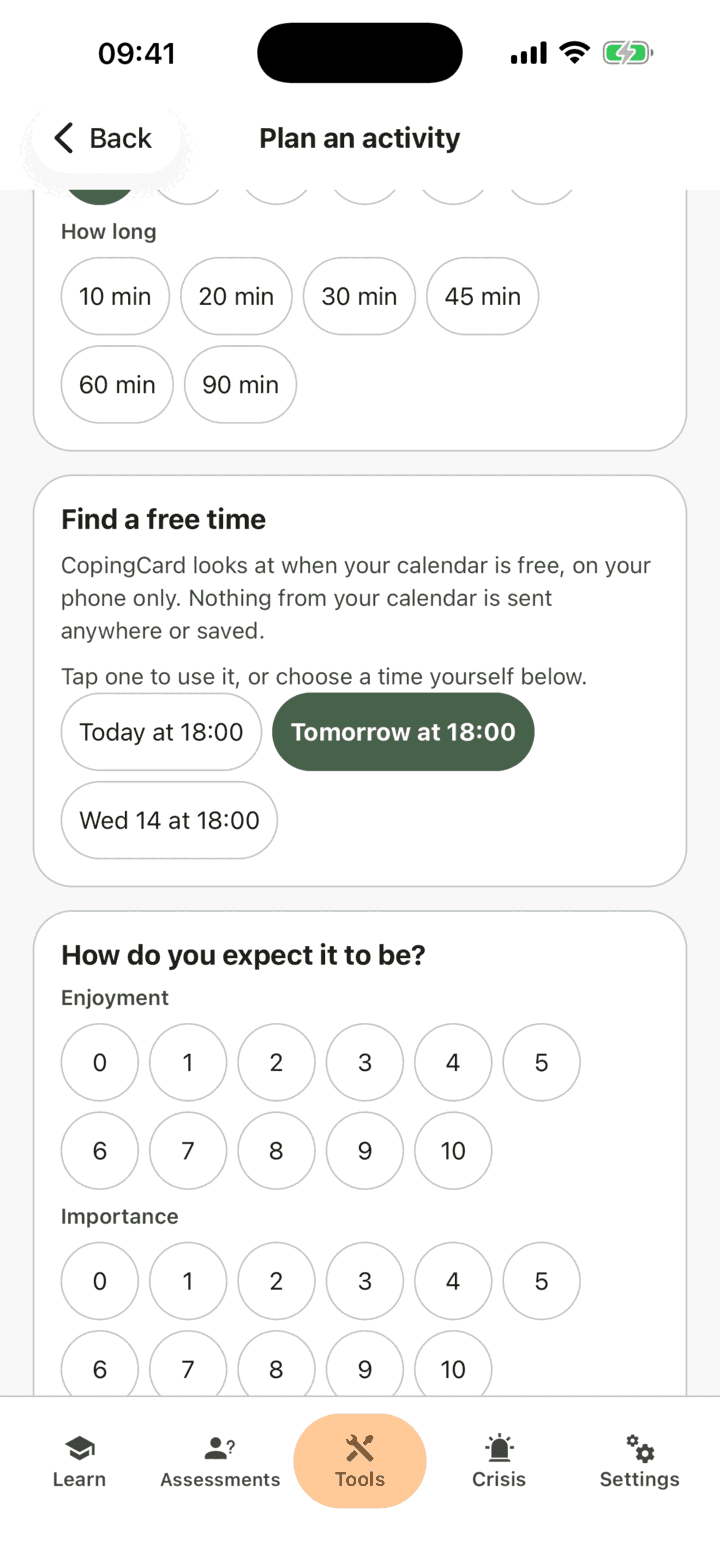
4. Plan the step, and plan around the obstacle. If you notice you doubt you will do it, make the step smaller or add support, such as asking a friend to join. Asking someone to walk with you, or to text you before football, is part of the plan, not a lack of willpower.
5. Do it, then rate it. Afterwards, rate Enjoyment and Importance again and compare with your prediction. Sometimes the experience beats the prediction.
6. If it did not happen, ask what got in the way. Rain, tiredness, a message you did not answer. A missed plan is information: the step needs to change, not the person. Make it smaller, move it, or add support.
What the evidence shows
Dimidjian and colleagues (2006) randomized 241 adults with major depression to behavioral activation, cognitive therapy, antidepressant medication or placebo. In the more severely depressed group, BA did as well as medication and better than cognitive therapy in that trial; among less severe cases the treatments were similar. Richards and colleagues (2016) ran the COBRA trial in UK primary care. It compared BA on its own, delivered by junior mental health workers, with a full CBT package (cognitive and behavioral work together) delivered by experienced therapists: at 12 months BA alone did as well, and cost less. Both findings come with the usual caveats: they are single trials, with attrition, and not every person responds.
BA is also practical to teach. That does not make it easy, but it can be delivered briefly and by people without years of training. It combines well with cognitive work, with medication where a clinician advises it, and with other tools in this app.
What the app adds to a paper activity chart
A paper chart works only if you fill it in, and low mood is exactly when people stop. Behavioral Activation adds help at the points where the method tends to slip.
- Prompts to log. Three quiet reminders a day ask "What have you been doing since...?", by default at 11:00, 16:00 and 21:00. You can change the times or turn them off. BA starts from a daily record of activity and mood, and brief protocols build their later steps on it (Lejuez and colleagues, 2011).
- A planned step arrives as a nudge. When you plan an activity for a day and time, it goes on your Homework list and a nudge arrives then. You can add a copy to your calendar, or ask the app to suggest free hours; it reads your calendar on your phone only, when you ask, and sends nothing anywhere.
- Expected against actual. You say how enjoyable and important you expect a step to be, then rate it afterward. Because low mood is a poor forecaster, the comparison is often the evidence BA is after (Lejuez and colleagues, 2011). The week view also shows hours by life area, what most often got in the way, and your check-in mood beside the activities you did each day.
- Ideas that start from your values. Activities come with ideas for each life area, and ideas for the values you ranked in Values appear first, with a rough difficulty.
- Your phone's own record. If you share your phone's activity data with CopingCard, walks and workouts it recorded are offered for the log. Nothing is logged until you tap.
- Work on it with your therapist. If you share your data with a therapist in CopingCard, you can go through your week, plans, ladder and ratings together; they can plan a step with you in session, or assign a step. It lands on your Homework list.
These features make BA's own steps (monitoring, scheduling, rating, review) easier to keep up: they support the method.
How to use Behavioral Activation in CopingCard
The Behavioral Activation tool follows these steps.
- Log an hour. Write down what you did, with how much you enjoyed it and how important it felt. The log shows patterns quickly.
- Choose activities. Pick things from areas such as relationships, education and work, recreation and interests, mind, body and spirit, and daily responsibilities.
- Put them in order. Rank them from easiest to hardest to build your own ladder.
- Plan an activity. Set a day and time, and add support if you want it.
- Mark what happened. Done, or it did not happen. If it did not, say what got in the way.
- Review your week. Look at what you did, how it felt, and what to plan next.
If you share with a therapist, they can see your plan and ratings, which makes it easier to adjust the steps in session. Rating-based tools like this one work best alongside a conversation about what the activity is doing for you.
Tips
- Plan the easiest thing first. One completed step makes the next more likely.
- Ask what an avoided activity gives you relief from. That is the useful information.
- Choose some activities because they matter to you, not because they are on a duty list.
- Be kind about missed plans.
- Do not compare a small step with what you used to do.
When to get more help
Low mood is common, and small steps often help. But if your mood has been low for weeks, if you cannot manage the basics of daily life, or if you have thoughts of harming yourself or that life is not worth living, please speak to a therapist or your doctor as soon as you can. You do not have to deal with this alone. In a crisis, open the Crisis tab or contact local emergency services.
Summary
Behavioral activation works on the function of what you do. Avoidance pays off at once with relief and costs more later, so life shrinks and mood falls. TRAP names the pattern, TRAC replaces the avoidance with a small step, and rumination is treated as avoidance too. It works alongside real-life circumstances, has good trial evidence, and combines with other CBT methods.
Sources
- Lejuez, C. W., Hopko, D. R., Acierno, R., Daughters, S. B., & Pagoto, S. L. (2011). Ten year revision of the brief behavioral activation treatment for depression: Revised treatment manual. Behavior Modification, 35(2), 111-161.
- Martell, C. R., Dimidjian, S., & Herman-Dunn, R. (2010). Behavioral Activation for Depression: A Clinician's Guide. Guilford Press.
- Dimidjian, S., et al. (2006). Randomized trial of behavioral activation, cognitive therapy, and antidepressant medication in the acute treatment of adults with major depression. Journal of Consulting and Clinical Psychology, 74(4), 658-670.
- Richards, D. A., et al. (2016). Cost and outcome of behavioural activation versus cognitive behaviour therapy for depression (COBRA). The Lancet, 388, 871-880.