Schema Modes: The Parts of You That Take Over
Dan is in a team meeting when his manager points out an error in his report. It is a small error, and the manager is calm about it. Within seconds, though, a familiar voice starts in Dan's head: "You're useless." He feels his face go hot and, under the voice, something smaller and older: shame, as if he were a child in trouble. He says "fine, I'll fix it" and stays quiet for the rest of the meeting. That evening he feels very little. He scrolls on his phone for hours and goes to bed late.
Most people know moments like this, when a part of them seems to take over and they react in a way that feels bigger, or older, than the situation. Schema therapy has a name for these states: modes. This article explains what modes are, the fourteen modes that are most often described, why the aim is to strengthen one of them, the Healthy Adult, and how to notice your own modes, on paper or in CopingCard.
Schema therapy in the CBT family
Schema therapy was developed by Jeffrey Young for people whom standard cognitive therapy did not help enough, often people with long-standing patterns in how they feel about themselves and relate to others. It is a member of the cognitive behavioral therapy (CBT) family, and it joins cognitive and behavioral methods with experiential work and attention to the therapy relationship.
Its starting point is a set of core emotional needs that every child has: secure attachment and acceptance, autonomy and competence, freedom to express needs and feelings, spontaneity and play, and realistic limits. When these needs are repeatedly unmet, lasting patterns can form, called early maladaptive schemas. A schema is a deep theme, such as "I am defective" or "people will leave me", made of memories, feelings, body reactions and beliefs. If you have read about core beliefs and the downward arrow, a schema is the developmental side of the same idea.
A schema is like a trait: it stays with you over years. A mode is what you are in right now.
What a mode is
A mode is the emotional state and way of coping that is active at a given moment. It is a mix of feeling, thought, body sensation and action, and it can take over for minutes or hours and then give way to another. Modes can switch quickly, and several can be present at once. A child mode is often covered by a coping mode that keeps the pain out of sight.
Each mode once made sense. A child who learns that showing feelings leads to trouble may learn to switch them off, and that detached state protected them then. In adult life the same mode can cut a person off from support, joy and the chance to have their needs met.
The fourteen common modes
The researchers who developed the Schema Mode Inventory, a questionnaire for clinicians and researchers, described fourteen modes. They fall into four groups. Here they are with the names and one-line descriptions CopingCard uses. (In the clinical literature the critic modes are often called parent modes.)
| Group | Mode | In one line |
|---|---|---|
| Child modes | Vulnerable Child | feeling small, lonely, scared or overwhelmed |
| Angry Child | angry and frustrated when needs aren't met | |
| Enraged Child | rage that feels out of control | |
| Impulsive Child | acting on urges right away, without thinking of later | |
| Undisciplined Child | giving up when things get boring or hard | |
| Happy Child | playful, spontaneous, at ease | |
| Coping modes | Compliant Surrender | giving in and pleasing others, my own needs last |
| Detached Protector | shutting off feelings, going numb or distant | |
| Detached Self-Soother | numbing or distracting myself with work, scrolling, food or other habits | |
| Self-Aggrandizer | needing to feel superior, special or in control | |
| Bully and Attack | attacking or controlling others before they can hurt me | |
| Critic modes | Punitive Critic | harsh self-blame, feeling I deserve to be punished |
| Demanding Critic | relentless pressure: nothing is ever enough | |
| Healthy Adult | Healthy Adult | wise, caring and balanced; looks after my needs |
Nobody has all of them strongly, and the names are only a starting point. In therapy, people often rename their modes in their own words: "The Judge" for the critic, "Little Dan" for the vulnerable child, "Autopilot" for the detached state.
Dan's moment, mode by mode
Looked at through modes, Dan's meeting is not one reaction but a sequence.
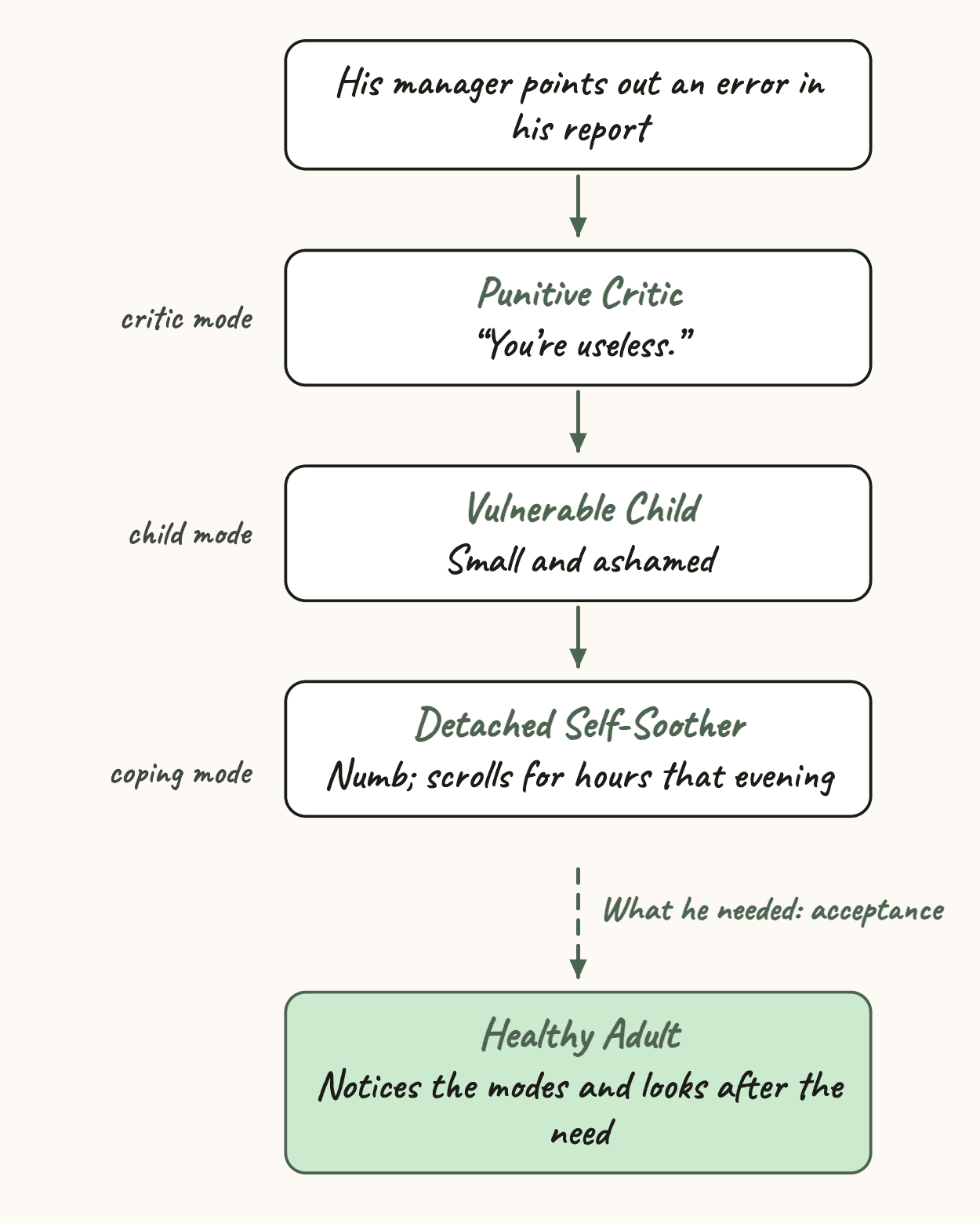
The Punitive Critic speaks first. The Vulnerable Child feels the shame. By the evening, the Detached Self-Soother has taken over and numbs the feeling with hours of scrolling. Each mode is doing something understandable. None of them gives Dan what he needed in that meeting, which was acceptance: the sense that an error is an error, not a verdict on him.
The Healthy Adult
The aim of schema therapy is not to fight the other modes or get rid of them. It is to strengthen the Healthy Adult: the part that notices what is happening, looks after the needs of the child modes, sets limits on the critic, questions the coping modes and chooses what to do next. For Dan, the Healthy Adult might say: "That was the critic again. I made a small mistake, I can fix it, and I still feel ashamed. What I need now is some kindness, not a lecture."
Therapists help build the Healthy Adult in several ways:
- The therapy relationship. The therapist meets some of the needs that went unmet, within the limits of therapy (limited reparenting), and models the Healthy Adult.
- Chair work. Different modes are given different chairs, so that the person can hear the critic, answer it and comfort the child.
- Imagery. Imagery rescripting returns to a painful memory and changes what happens in it, so that the child's needs are met.
- Flashcards. A short card, written in session, that names the mode, the need underneath and what the Healthy Adult would say and do.
- Behavioral pattern-breaking. Trying new behavior in place of the old coping modes, step by step.
The first step in all of these is the same: noticing modes as they happen, between sessions, in ordinary life. Research supports giving this mode its central place. In a three-year trial, the strength of the Healthy Adult and Vulnerable Child modes predicted later change in personality problems, more than the other way round, which suggests they are mechanisms of change.
Noticing your modes
You can keep a simple mode diary on paper. When a strong feeling comes, note which modes are present and how strong each one is, what set them off, where you feel it in your body and what you needed. After a week or two, patterns appear: the same trigger, the same critic, a coping mode that turns up every evening. The paper version has two weak spots. It is easy to forget in the moment, and a stack of notes is hard to read back. To look at what one behavior inside a mode does for you, see Functional Analysis.
Step by step in CopingCard
-
Set up your modes. Open Schema modes in the tools, then Edit my modes. Start from The common seven (Vulnerable Child, Angry Child, Happy Child, Detached Protector, Punitive Critic, Demanding Critic and Healthy Adult) or All fourteen. Turn on the modes you know in yourself, give each a name In my words and a color. You can Add my own mode (up to six) and say whether it is a child, coping or critic mode. The Healthy Adult is always on.
-
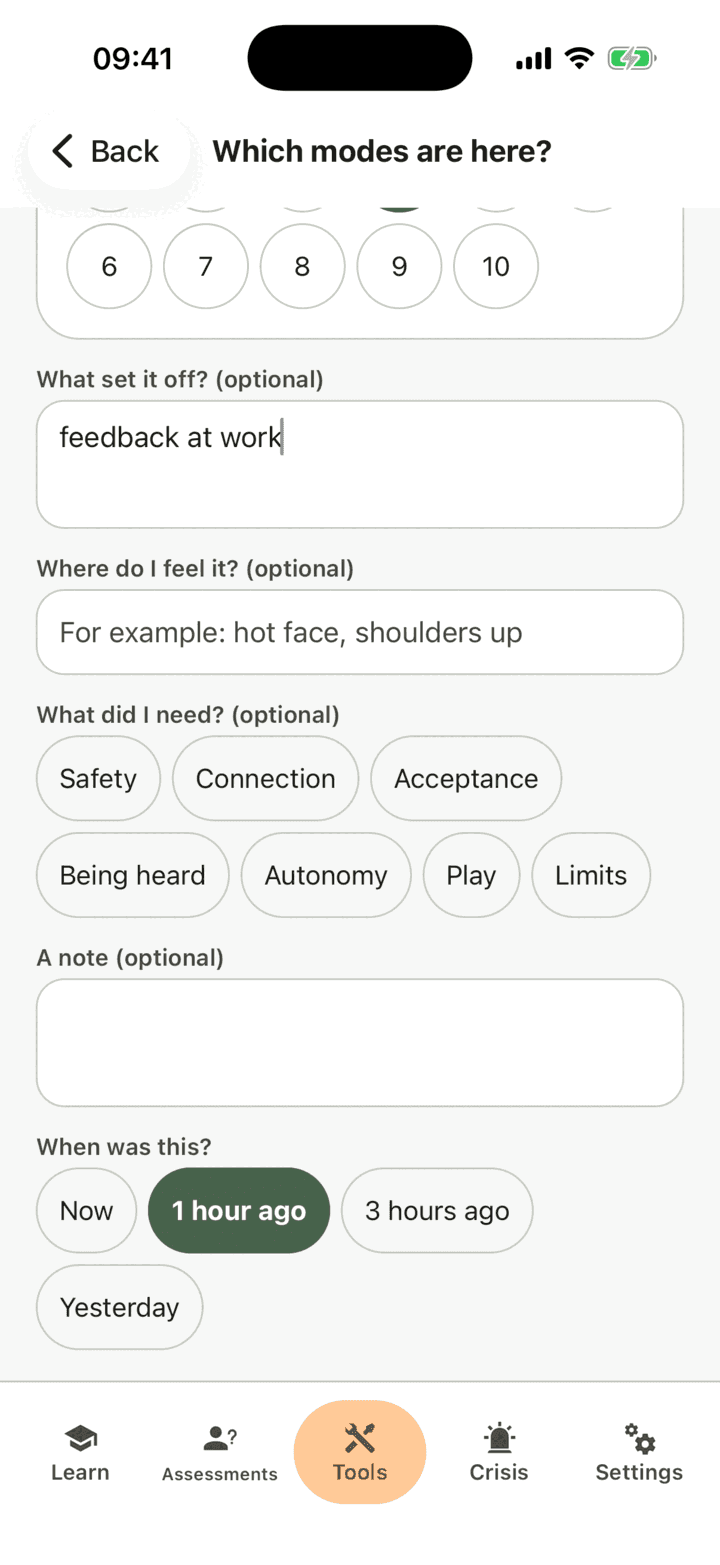
Check in. When something shifts, tap Which modes are here now? Tap every mode that is present, because several can be, and rate each from 0 to 10. If you like, add what set it off, where you feel it, what you needed (such as safety, connection, acceptance or being heard) and a note. A check-in can be for now or for earlier in the last two days.
-
Link a card. You can link one of your coping cards to a mode, for example a card that answers the critic. After a check-in, the card of the strongest difficult mode that has a card opens, because you linked it.
-
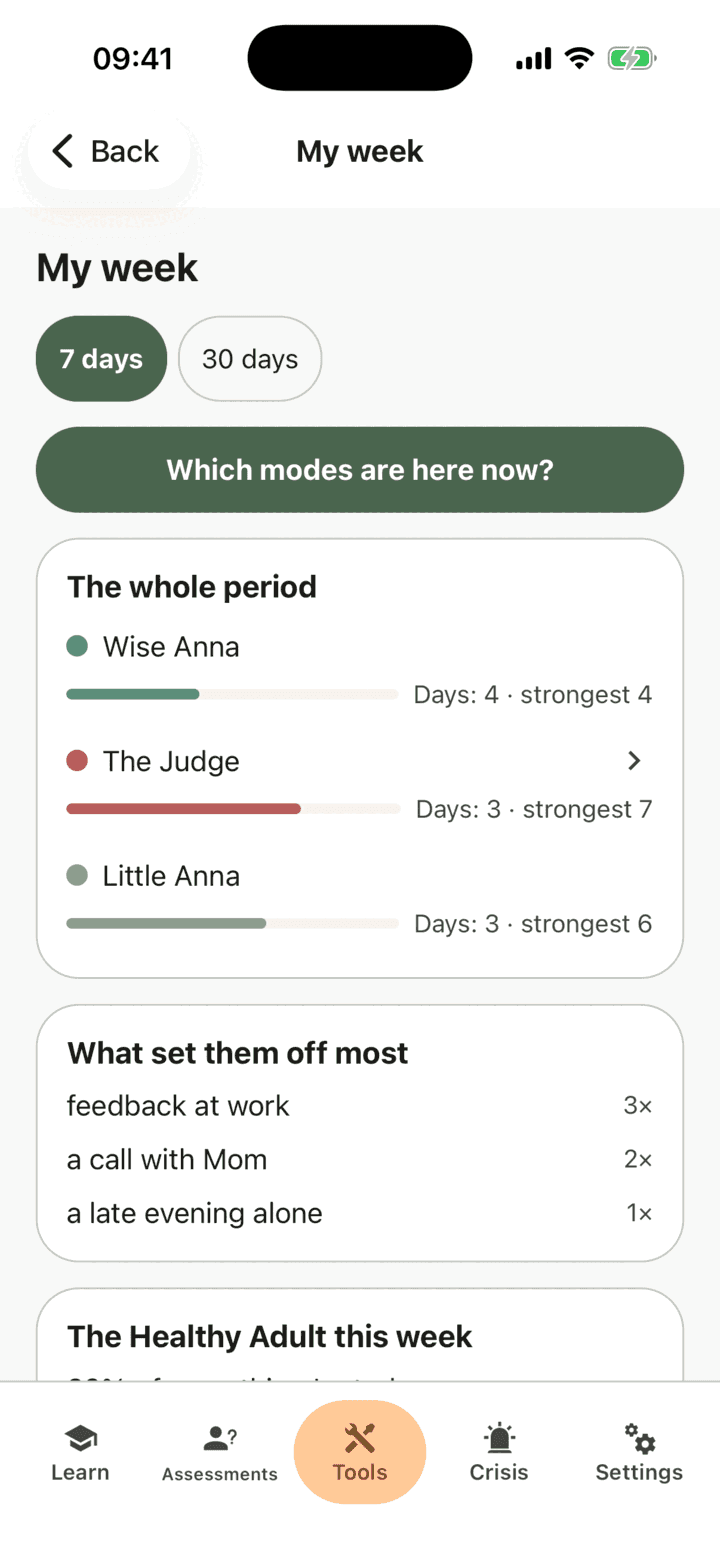
See your week. My week starts with the whole period: which modes showed up, on how many days and how strong at most. It then shows what set them off most often and how much the Healthy Adult was there, and a row for each day you can open for its bars. The free plan shows the last seven days; with Premium you see your whole history.
-
Get a nudge. Three quiet prompts a day, at times you can change, remind you to check in.
The app keeps your words and your numbers. It does not score you, label you or draw conclusions for you.
With a therapist
If you work with a schema therapist, the modes can be set up with them in session from your formulation, in your words. Either of you can change the set later; the latest change counts, and the screen shows who made it. Your therapist can also ask for daily mode check-ins as homework.
In the portal, a therapist you share your data with sees a mode map, the peak intensity of each mode by day, which triggers came with which modes, and the Healthy Adult week by week. It is display only: no alerts, scores or advice. A therapist sees this only if you allow them to view your data; see Choose what your therapist can see. For the screens step by step, see the schema modes page in the help center.
What the research says
Schema therapy has been tested in randomized trials for personality disorders. In a three-year trial for borderline personality disorder, more people recovered with schema therapy than with transference-focused psychotherapy. A multicenter trial for other personality disorders, including avoidant, dependent and obsessive-compulsive personality disorders, found more recovery with schema therapy than with treatment as usual. A recent trial for borderline personality disorder found that a combination of individual and group schema therapy worked better than treatment as usual. Our research library has summaries of two schema therapy studies and of a qualitative study of how people experience group schema therapy.
When to get more help
Working with modes touches old and painful material. Noticing a critic or a vulnerable child can bring up strong feelings, and that is understandable. Schema therapy is usually a long treatment, often a year or more, and it is best done with a trained schema therapist. If your feelings are heavy or last for days, talk to your therapist or doctor. If you feel unsafe at any point, open the Crisis tab in the app, or contact your local emergency services. For working with a harsh inner critic, see also Being on your own side: self-kindness.
In short
- A mode is the state that has you right now: a child, coping or critic mode, or the Healthy Adult.
- Modes switch, several can be present at once, and each once made sense as protection.
- Under a difficult mode there is usually a need, such as acceptance or safety.
- Schema therapy aims to strengthen the Healthy Adult, not to fight the other parts.
- In CopingCard you name your modes in your own words, check in in seconds, link a card to a mode and see your week.
Sources
- Young, J. E., Klosko, J. S., & Weishaar, M. E. (2003). Schema Therapy: A Practitioner's Guide. Guilford Press.
- Arntz, A., & Jacob, G. (2013). Schema Therapy in Practice: An Introductory Guide to the Schema Mode Approach. Wiley-Blackwell.
- Lobbestael, J., van Vreeswijk, M., Spinhoven, P., Schouten, E., & Arntz, A. (2010). Reliability and validity of the short Schema Mode Inventory (SMI). Behavioural and Cognitive Psychotherapy, 38(4), 437-458.
- Arntz, A., & Weertman, A. (1999). Treatment of childhood memories: Theory and practice. Behaviour Research and Therapy, 37(8), 715-740.
- Giesen-Bloo, J., et al. (2006). Outpatient psychotherapy for borderline personality disorder: Randomized trial of schema-focused therapy vs transference-focused psychotherapy. Archives of General Psychiatry, 63(6), 649-658.
- Bamelis, L. L. M., Evers, S. M. A. A., Spinhoven, P., & Arntz, A. (2014). Results of a multicenter randomized controlled trial of the clinical effectiveness of schema therapy for personality disorders. American Journal of Psychiatry, 171(3), 305-322.
- Arntz, A., Jacob, G. A., Lee, C. W., et al. (2022). Effectiveness of predominantly group schema therapy and combined individual and group schema therapy for borderline personality disorder: A randomized clinical trial. JAMA Psychiatry, 79(4), 287-299.
- Yakın, D., Grasman, R., & Arntz, A. (2020). Schema modes as a common mechanism of change in personality pathology and functioning: Results from a randomized controlled trial. Behaviour Research and Therapy, 126, 103553.