Functional Analysis: What a Behavior Does for You
Sam is a student. Three days a week his first class starts at 8:30, and on most of those mornings he turns off his alarm, goes back to sleep and misses it. He knows it is not helping. He has promised himself more than once that next week will be different, and by Wednesday it has happened again. If you asked him why, he would probably say something hard on himself: "I'm lazy" or "I have no willpower".
Functional analysis asks a different question. Not "why do I do this?" but "what does this behavior do for me?" A behavior that keeps coming back is usually doing a job, even when it also costs a lot. This article explains where the method comes from, how to lay a behavior out as a chain, what its common functions are, and how to test one small change, on paper or in CopingCard.
Where functional analysis comes from
Functional analysis began in behavior therapy. Its basic idea is that what we do is shaped by what comes before it and, above all, by what follows it. A behavior that brings relief, a reward or someone's attention tends to happen again. In a well-known series of studies, Brian Iwata and colleagues showed that the same problem behavior can serve different purposes for different people. A later review of studies that compared both kinds of treatment with the same people found that treatment matched to the purpose worked far better than treatment that was not.
Cognitive behavioral therapy (CBT) took this idea in early, and today it is part of the family's everyday work:
- Case formulation. A CBT therapist builds an individual map of what keeps a person's difficulties going. The functional question, "what is this doing for you?", sits at its center.
- Chain analysis in DBT. Dialectical behavior therapy, developed by Marsha Linehan, uses a detailed chain analysis: you go link by link through what made you vulnerable, what set the behavior off, the thoughts, feelings and body sensations in between, the behavior itself and what followed.
- Behavioral activation. In depression, behavioral activation looks at avoidance in the same way: a pattern that brings relief now and keeps life narrow later.
- Process-based therapy. Process-based therapy (PBT), the newer approach of Stefan Hofmann and Steven Hayes, maps how one person's own processes, such as thoughts, feelings, attention and actions, feed each other. Its researchers treat that personal map as an empirical functional analysis of that person. PBT borrows three questions from evolution that sharpen the functional view. Variation: how many different ways does the person respond in this situation, or is it always the same one? Selection: what does the response pay off right away, which is why it wins over the others? Retention: what keeps it going until it becomes a habit? For Sam, there is one response to the alarm, the payoff is the warm bed and more sleep, and the habit is kept by the late nights spent studying to catch up. The mornings when he did get up, for example when he had arranged to meet someone, show that other responses are possible.
So functional analysis is not a separate therapy. It is a way of looking that many CBT methods share. It works on behavior and its consequences, and it pairs naturally with methods that work on thoughts and feelings.
A behavior as a chain
The first step is to describe one occasion in detail, link by link, without judging it. Here is one of Sam's early mornings.
- Before. He went to bed after 2 a.m., studying to catch up on the classes he missed. A vulnerability like poor sleep, hunger, illness or a hard day makes everything that follows harder.
- The trigger. The alarm goes off at 7:30.
- Thought and feeling. "Ten more minutes. I'll catch up on my own later anyway." He feels heavy and tired, and the day ahead feels like a lot.
- The behavior. He switches the alarm off and goes back to sleep.
- Right away. He stays in a warm bed and sleeps a little longer. The rushed, hard start of the day is put off.
- Later. He misses the lecture and falls further behind. That night he stays up late studying to catch up again, and the next early morning is even harder.
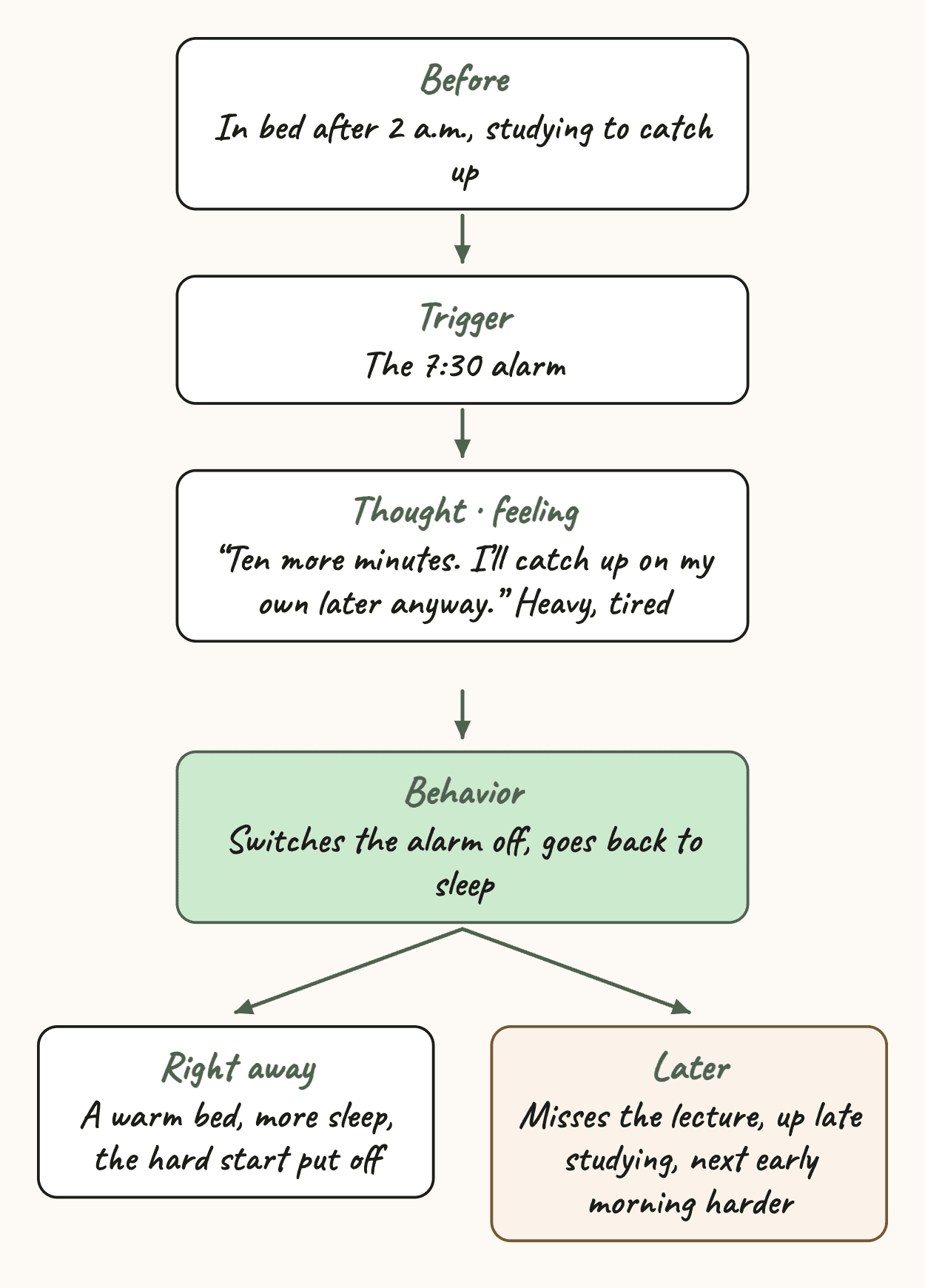
Written down like this, the pattern stops looking like a flaw in Sam's character. It looks like a sequence with a logic, and every link in a sequence is a place where something could go differently.
What a behavior can do
The question "what did it do right away?" usually points to the behavior's function. Four functions come up again and again:
- Escape or avoidance. It gets you out of, or away from, something hard or scary. Sam's staying in bed does this in part: the rushed start of a long day is put off.
- Attention. It brings other people closer: they notice, check in or help.
- A tangible gain. It gets you something you want: a break, a treat, a thing. For Sam, it is a warm bed and more sleep.
- Automatic relief. It calms a feeling or a body sensation right away, with no one else involved.
One behavior can serve more than one function, and the same behavior can serve different functions for two people. That is why a function is worked out for this person, from this person's records, rather than assumed.
Right away and later: both are true
The most useful part of the chain is often the split between what happens right away and what happens later. The relief right away is real, and it is exactly why the behavior repeats: a behavior that ends something unpleasant is strengthened by that ending. The cost comes later and is spread out, so it pulls far less on the next decision.
Seeing both side by side explains the pattern without blaming anyone. Sam is not choosing to fall behind. In the moment, he is choosing more sleep and a slower start, and he gets them. The cost lands later, and it even feeds the next round: the late night of studying to catch up makes the next alarm harder. Behavioral activation calls this a trap: a trigger, a response, and an avoidance pattern that brings short-term relief and long-term cost.
From a hunch to a test
A function is a hypothesis, not a verdict. The way to find out whether it is right is to change one link and watch what happens.
- Pick one link. You can change what comes before the behavior (the vulnerability or the trigger), add something in the middle (a different response to the thought or the urge), or change what follows it.
- Start from a set day. A date makes it possible to compare before and after.
- Say what you expect. Writing down a prediction turns a plan into a small experiment.
- Check. Did the behavior change? And how often did you actually do the change? A plan that was carried out on two days out of seven tells you something different from one that was carried out every day.
For Sam, the hard moment is the alarm itself: once he is out of the door, he goes to class. So his plan changes what getting up leads to. From next Monday, on his three early days, he meets a classmate for coffee at 8:10 by the lecture hall. Getting up now ends with company, and staying in bed means letting someone down. He expects the alarm to feel just as hard, and to get up on most of those days anyway.
A before-and-after comparison is evidence, not proof. Other things change too: the term gets busier, sleep gets better or worse. That is why this kind of test is worth doing with a therapist, who can help read the result and decide what to try next.
How it fits with other CBT tools
Functional analysis works on what a behavior does. Other tools look at the same moment from another side:
- The ABC model looks at the belief between a situation and your reaction.
- Vicious cycles map how thoughts, feelings, body and actions keep a problem going in a loop.
- Behavioral activation works on avoidance in low mood, step by step.
- Avoidance and exposure helps when the function is escape from fear.
- Motivational interviewing helps when you see what the behavior does and still feel two ways about changing it.
- Schema modes look at the parts of you that take over, which is often where a behavior starts.
A therapist often combines them: the chain shows that a behavior is escape, and an exposure plan or a planned activity becomes the change Sam tests.
Step by step in CopingCard
You can do all of this on paper. The app helps with the parts that are easy to lose: remembering to record, seeing what repeats across many records, and keeping track of whether the change was done.
-
Choose what to look at. Open Functional analysis and tap + Add a behavior. Write it in your own words ("skipping my first class"), what counts as one, how to measure it (how many times, how many minutes, or how strong from 0 to 10) and what you think it does for you. "Not sure yet" is a fine answer. You can look at up to three behaviors at a time.
-
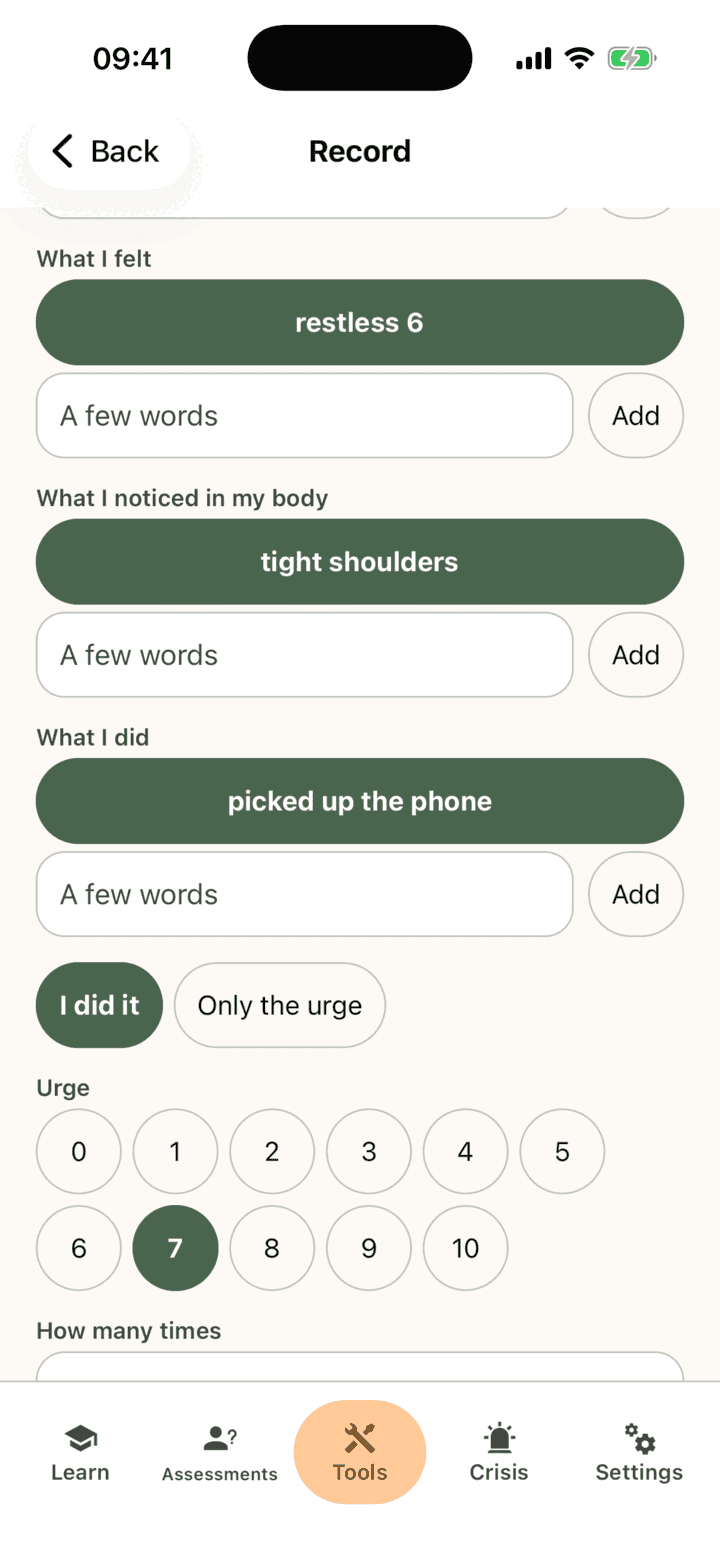
Record it. Tap Record when it happens, or when you only feel the urge: Only the urge is a record too, with how strong the urge was. The record walks through the chain: what made you vulnerable (chips such as Slept badly or A hard day), what set it off, what you thought, felt, noticed in your body and did, then what it did Right away and Later, and what you could change Next time. You can add a tool that could help, such as a coping card or a planned activity, and open it from there. A record can be for today or for up to seven days ago.
-
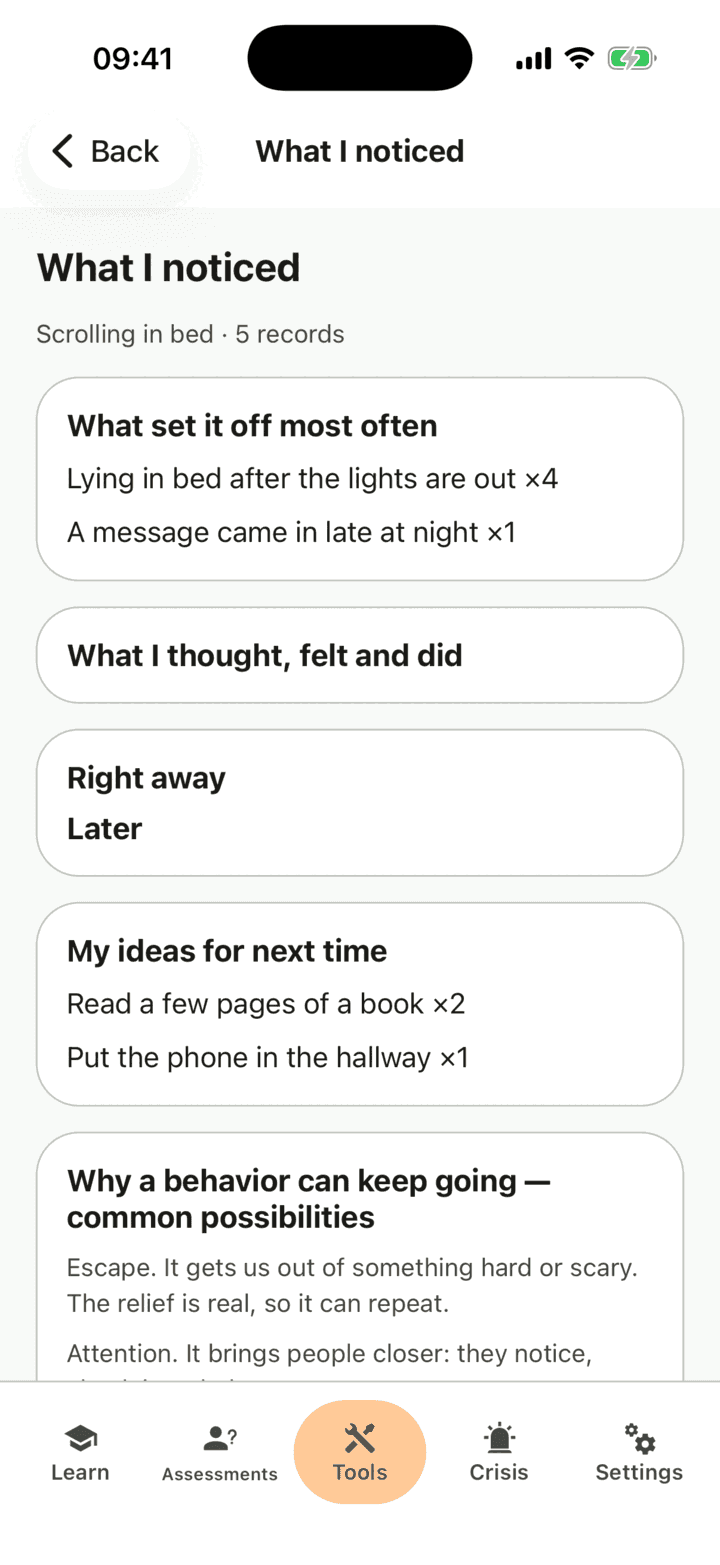
See what you noticed. After about five records, What I noticed shows what set the behavior off most often, what you thought, felt and did, what it did right away and later, and your own ideas for next time, all in your own words and counted. Nothing is scored, and the app draws no conclusions for you.
-
Plan a change. Plan a change takes your most repeated idea for next time as a starting point. You can change it, say what you expect, and choose the day it starts.
-
Track it. Each day, tap whether you did the planned change: yes, partly or no. The list shows how many days you did it.
-
Close it. When you are done, I'm done with this takes the behavior off your list. Your records stay.
With a therapist
Functional analysis was made for therapy, and it is at its best there. If you work with a therapist, they can set a behavior with you in session, including what counts as one and the function you both suspect, and ask you to record it as homework. In the portal they see your records laid out as a formulation, and after a change, the weeks before and after it side by side, with the days you marked. A behavior set in session shows as Set with my therapist and is changed or closed in session.
Your records are yours. A therapist you are connected to sees them only if you allow them to view your data; see Choose what your therapist can see. For the screens step by step, see the functional analysis page in the help center.
When to get more help
Looking closely at a behavior you struggle with can be uncomfortable, and that is understandable. If the behavior is harming you, such as self-harm, heavy drinking or drug use, or if it keeps getting worse, please work on it with a therapist or doctor rather than alone. If you feel unsafe at any point, open the Crisis tab in the app, or contact your local emergency services.
In short
- Functional analysis asks what a behavior does for you, not why you "can't stop".
- A chain shows what came before, the behavior, and what followed right away and later.
- Escape, attention, a tangible gain and automatic relief are common functions; relief now and cost later can both be true.
- A function is a hypothesis: change one link from a set day, say what you expect, and check, ideally with a therapist.
- CopingCard records the chain, shows what repeats, and tracks the change you planned.
Sources
- Iwata, B. A., Dorsey, M. F., Slifer, K. J., Bauman, K. E., & Richman, G. S. (1994). Toward a functional analysis of self-injury. Journal of Applied Behavior Analysis, 27(2), 197-209. (Reprinted from Analysis and Intervention in Developmental Disabilities, 2, 3-20, 1982.)
- Hurl, K., Wightman, J., Haynes, S. N., & Virues-Ortega, J. (2016). Does a pre-intervention functional assessment increase intervention effectiveness? A meta-analysis of within-subject interrupted time-series studies. Clinical Psychology Review, 47, 71-84.
- Linehan, M. M. (2015). DBT Skills Training Manual (2nd ed.). Guilford Press.
- Martell, C. R., Addis, M. E., & Jacobson, N. S. (2001). Depression in Context: Strategies for Guided Action. W. W. Norton.
- Persons, J. B. (2008). The Case Formulation Approach to Cognitive-Behavior Therapy. Guilford Press.
- Hofmann, S. G., & Hayes, S. C. (2019). The future of intervention science: Process-based therapy. Clinical Psychological Science, 7(1), 37-50.
- Sanford, B. T., Ciarrochi, J., Hofmann, S. G., Chin, F., Gates, K. M., & Hayes, S. C. (2022). Toward empirical process-based case conceptualization: An idionomic network examination of the process-based assessment tool. Journal of Contextual Behavioral Science, 25, 10-25.