Noticing Your Mood: Check-ins and the Diary Card
Maya felt that her moods were random. Some days were fine, some were heavy, and she could not say why. When she tried to describe it to her therapist, she found she could remember the last two days well and almost nothing before that.
Many people are in Maya's position. Memory is shaped by how we feel right now, and a bad day colors the whole week in hindsight. A simple record, kept in the moment, gives you something more reliable to look at. This article explains how the check-in and the diary card in CopingCard work, and how to get something useful out of them.
Why write it down?
Keeping records of mood and activity is a standard part of cognitive behavioral therapy (CBT), usually called self-monitoring. It helps for three reasons.
Memory is biased by mood. How you feel now colors what you remember. On a low day the whole week looks bad; on a good day the hard moments fade. A record made close to the moment is less distorted than a recollection a week later.
Recording changes what is recorded. Self-monitoring is both a way of measuring and an intervention. Noticing a pattern, such as a mood that drops after a poor night's sleep, is often the first step to changing it.
It gives therapy data. CBT treats ideas about what is going on as hypotheses to test. "Sundays are hard" is a hypothesis, and a few weeks of entries can support it or not. Your therapist gets something to work with besides impressions.
Self-monitoring is not meant to catch you out, and it is not a score to beat. It is a way of getting curious about your own week.
The check-in: one tap
The check-in is built to take a few seconds. When you open it, you see the question "How are you today?" and five faces, from very low to very good. Tap the one that fits. That is a complete check-in.
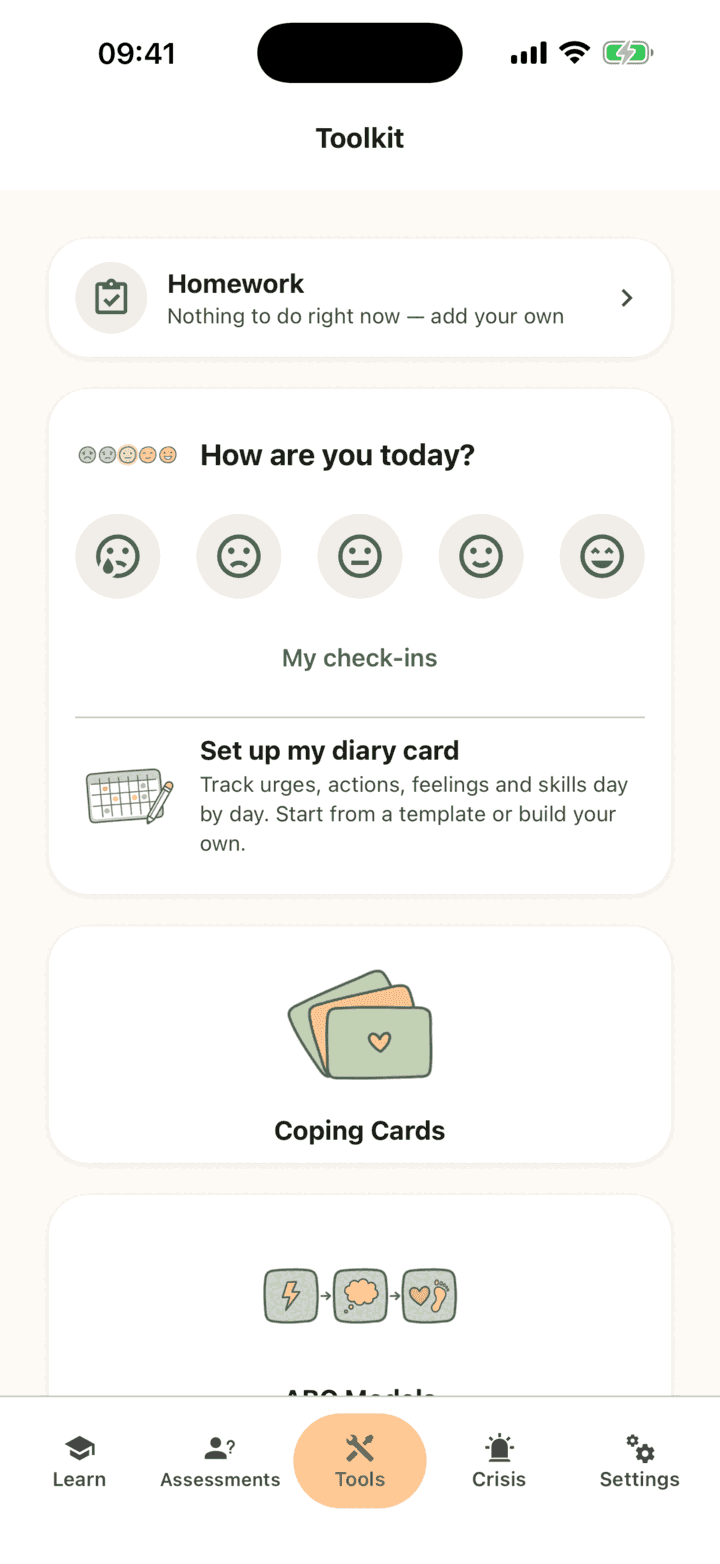
If you have another minute, you can add more detail. All of it is optional:
- Energy, from very low to very high.
- How well you slept, and the hours you slept.
- How connected you feel to other people.
- Feelings, chosen from a list, with how strong each one was: mild, moderate or strong.
- What shaped today, such as work, family, relationships, health, sleep, money, study or weather.
- A note, for anything you want to remember.
You can check in more than once in a day, and you can also fill in yesterday or any of the last seven days if you forgot. If you have no signal, the check-in is saved on your phone and sent when you are back online. A quiet daily reminder can help you build the habit.
Reading your history
My check-ins shows the last 7 or 30 days. You see a chart of mood over time, a streak of days in a row, and each entry with its note. A streak is only a gentle encouragement. Missing a day does not matter, and nothing is lost if you start again.
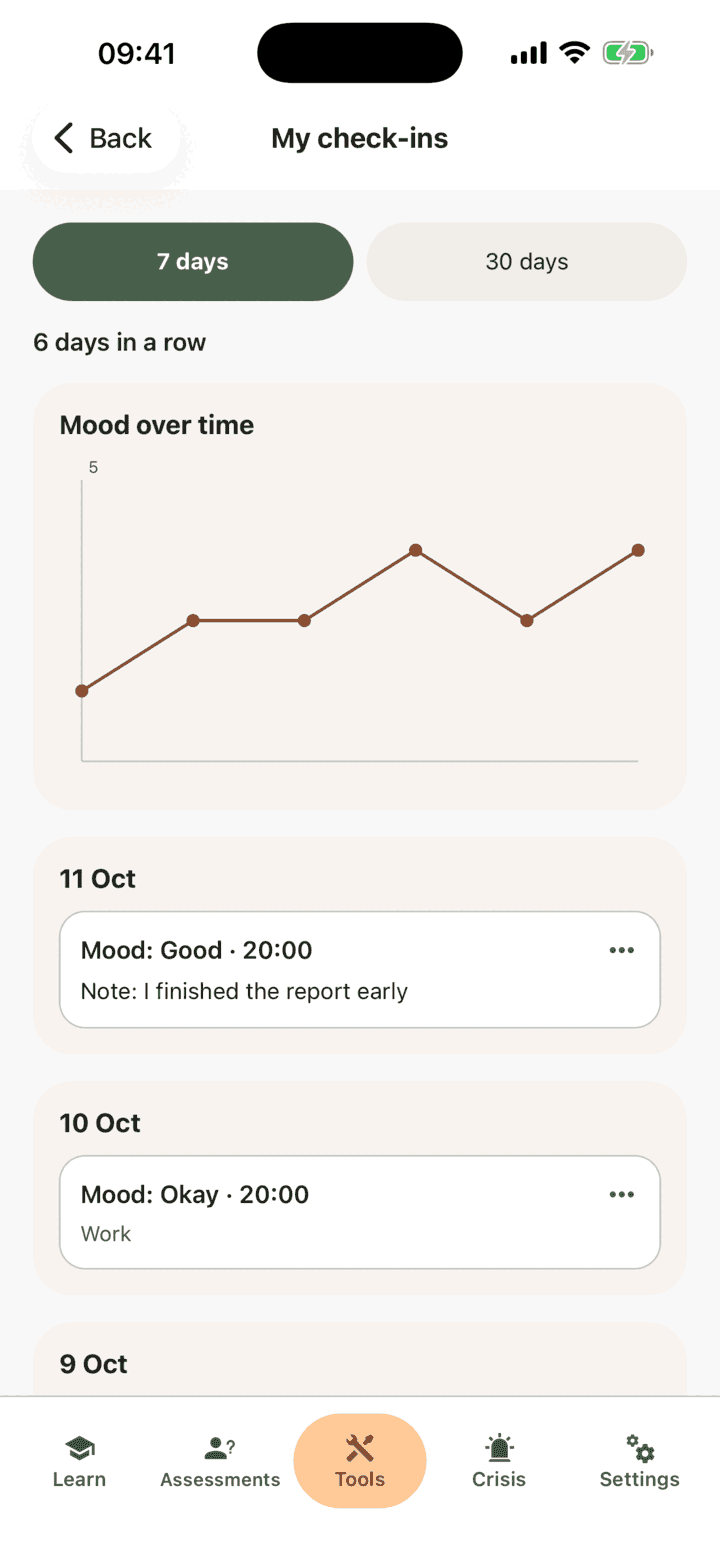
Give it a week or two before you read anything into the chart. One day tells you very little; a few weeks tell you a lot.
If you share your records with a therapist in CopingCard, they can see your check-ins. If you would rather remove one, you can delete it, and it disappears from your history and from your therapist's view.
What the app adds to a paper mood diary
A paper diary depends on remembering it, having it with you and writing at the right moment. Recording close to the moment is the whole point, and that is where the app helps.
- One tap from your home screen. A Check-in widget shows the five faces on your home screen. Tap one and the check-in is recorded, without opening the app (on iPhone with iOS 17 or later, and on Android). The widget shows nothing else, no history or notes. A second tap the same day opens the check-in so you can add detail.
- A daily reminder. Choose the time. Tapping the notification opens the check-in. The diary card has its own reminder.
- It works without signal. An entry made offline waits on your phone and is sent when you are back online.
- The chart does the counting. My check-ins draws mood over 7 or 30 days, so a pattern such as Maya's Sundays shows without you adding anything up.
- A recap for your therapist. If you share your records with a therapist in CopingCard, they see your check-ins over 14, 30 or 90 days, and before a session a recap since the last one: average mood, the lowest day, average sleep and the most common drivers. They can also assign a daily check-in as homework, and record one with you in the session, which is marked "entered in session".
- Links to other tools. Behavioral Activation shows your check-in mood beside the activities you did that day, which helps you see whether doing things and feeling better move together.
Why this matters has a research basis. Reports made close to the moment, in the person's own setting, avoid much of the distortion of recall, which is the rationale of ecological momentary assessment (Stone and Shiffman, 1994; Shiffman, Stone and Hufford, 2008). An easy widget is still no reason to check more often if the checking starts to feel anxious (see below).
What Maya found
Maya began checking in each evening. She picked a face and, when she had time, added a note. She did not try to explain anything.
After three weeks, she opened My check-ins and looked at the chart. The low points were not random. Most of them were Sundays. On the same days, her notes mentioned the coming week at work.
That was something to bring to her next session, and something to plan around. She decided to arrange a walk with a friend on Sunday afternoon and to go to bed a little earlier. Within a month, the Sunday dips had not disappeared, but they were smaller. More importantly, they no longer felt like they came from nowhere.
The diary card
A diary card goes a step further than the check-in. It is a one-minute daily record of the things that you and your therapist have decided to follow, such as urges, actions, feelings and the skills you used. It comes from dialectical behavior therapy (DBT), a third-wave therapy in the CBT family.
In DBT the card is more than a log. Its targets are ranked by priority, with life-threatening and therapy-interfering behaviors ahead of quality-of-life problems. The therapist reviews it at the start of the individual session and uses it to decide what to work on first. When a target behavior has occurred, the therapist and client choose an episode and examine it in a chain analysis, a step-by-step look at what led up to it and what followed. The card is how the week arrives in the room.
In CopingCard there are two ways to have one:
- From your therapist. If your therapist sets up a card for you, it appears in your app, and you fill it in each day.
- Your own. You can set one up for yourself. Start from a template or a blank card, and choose the rows you want to track. Your own card is private to you.
The daily form is one page. You choose the day (today or yesterday), rate the rows, and for feelings give the highest each one reached that day, from 0 to 5. Skills are rated from 0 (not thought about or used) to 7 (used them, and they helped). If you have more than one card, you still see one form, and a row that appears on several cards is asked once. If you fill in a day twice, the second time replaces the first. My week shows how the days compare.
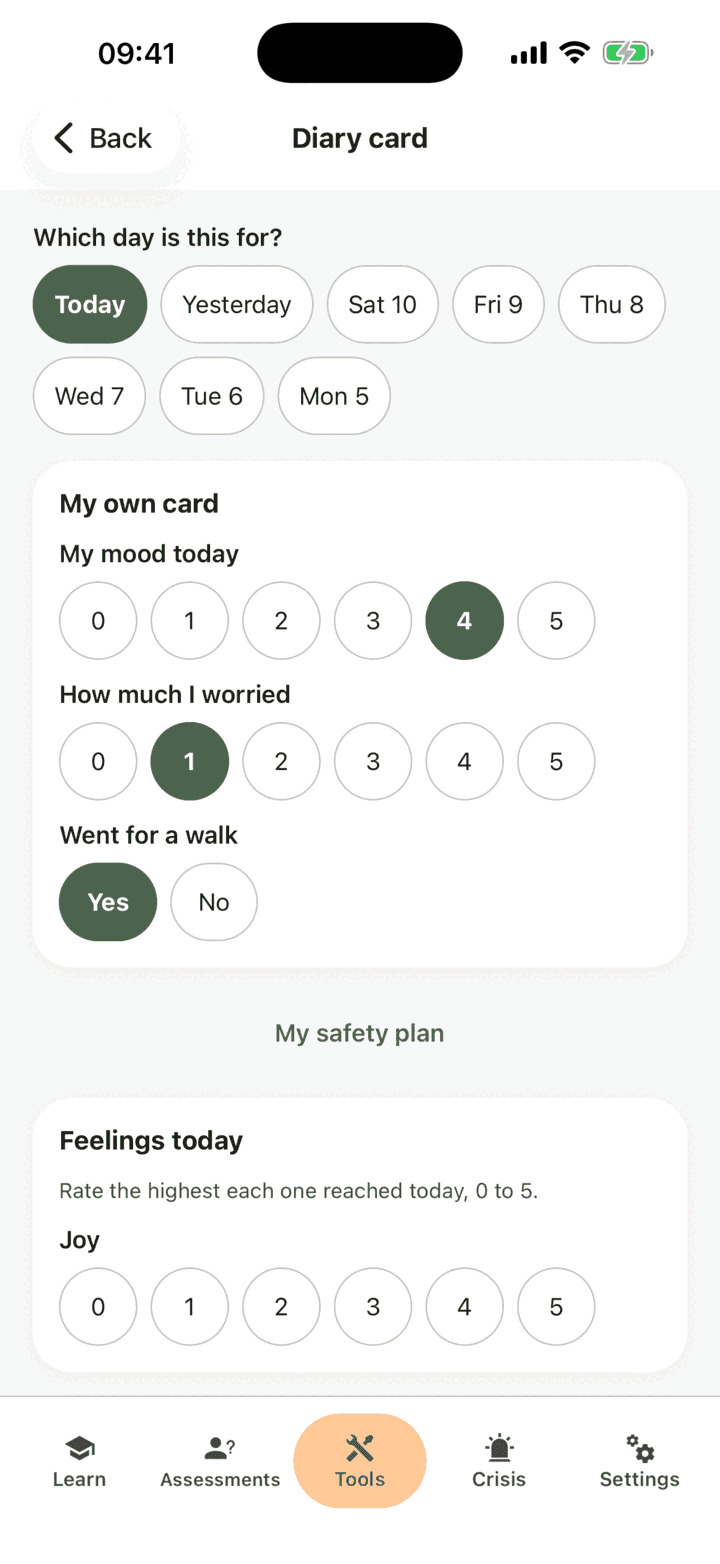
You can change the rows at any time. Days you already filled in keep the rows they had.
Track processes, not only mood
Mood is one thing to follow. Modern CBT also looks at processes, the things that keep difficulties going or help them ease: sleep, avoidance, worry, rumination, time with people, activity. A mood face tells you how the day felt; a note on what you did, avoided or ruminated about tells you what may be holding the pattern in place. The "what shaped today" options and the note are there for this. Maya's notes about the work week ahead were worth more to her therapist than the faces alone.
When monitoring stops helping
For some people, especially with anxiety or health worries, checking how they feel again and again turns into a way of staying on guard. If you notice that you are checking compulsively, or feeling worse after each entry, check in less often, or only at a fixed time, and tell your therapist. The record is meant to serve you, not the other way round.
Tips for making it a habit
- Attach it to something you already do. After brushing your teeth, or with your evening tea.
- Keep it small. The face alone is enough. On busy days, that is fine.
- Use the reminder. Choose a time that fits your day.
- Do not judge the numbers. A low mood is information, not failure.
- Look back weekly. A short look at your chart on the same day each week is more useful than checking daily.
Using it with your therapist
Bring the chart to your session, or share your data with your therapist so you can look at it together. Start with a question rather than a conclusion: "I noticed Sundays seem hard. What do you make of that?" Together you can look for what the pattern might mean and what you might try.
When to get more help
A check-in is a record, not an assessment, and it cannot tell you what is wrong. If your low points are getting lower, lasting longer or making daily life hard, talk to your therapist or your doctor. If you feel unsafe at any point, open the Crisis tab in the app, or contact your local emergency services.
In short
- One tap on a face is a complete check-in. Details are optional.
- Look at your history after a week or two, not after one day.
- A pattern is something to be curious about, not to judge.
- The diary card tracks the things that matter in your therapy, and you can set up your own.
- Bring what you notice to your therapist.
Sources: J. S. Beck, Cognitive Behavior Therapy: Basics and Beyond (3rd ed., 2021); Stone and Shiffman (1994), "Ecological momentary assessment (EMA) in behavioral medicine," Annals of Behavioral Medicine, 16(3), 199-202, on momentary assessment and recall; Marsha Linehan, Cognitive-Behavioral Treatment of Borderline Personality Disorder (1993) and DBT Skills Training Manual (2nd ed., 2015); Shiffman, Stone and Hufford (2008), "Ecological momentary assessment," Annual Review of Clinical Psychology, 4, 1-32; Hofmann and Hayes (2019) on process-based CBT.