Motivational Interviewing: Mixed Feelings About Change
Dan works long days. Most evenings he opens a beer as soon as he is home, then another. Nothing dramatic happens, but his mornings are foggy and he has started to notice what he spends. He has said "I should cut down" more than once. He has said just as often, "it's how I switch off, and I've earned it." Both are true for him, and each time he ends up where he started.
Most people know this place: a change you half want and half don't. This article is about a way of working with it, motivational interviewing (MI), and how to use it in CopingCard, alone or with a therapist.
Mixed feelings are normal
Feeling two ways about a change is called ambivalence. It is not laziness or denial. It is what a mind does when a habit has real benefits and real costs at once: Dan's beers do help him switch off, and they do cost him his mornings.
Ambivalence has a typical shape. When someone argues for the change, the person with mixed feelings tends to argue for the other side, and talks themselves a little further from change. In a classic trial with problem drinkers, the more a counselor confronted the client, the more the client resisted, and the more the client was drinking a year later. Arguing, lecturing and warning are what MI sets aside.
What MI is, and what it is not
Motivational interviewing was developed by William Miller and Stephen Rollnick. Miller first described it in 1983, from his work with people thinking about their drinking. It is a way of talking about change that draws out a person's own motivation, defined by its spirit more than by any technique: partnership, acceptance of the person and their right to choose, compassion, and drawing out the reasons and strengths the person already has.
MI is person-centered, in the tradition of Carl Rogers, yet it guides attention toward the person's own reasons for change. The current edition of Miller and Rollnick's book describes four tasks: engaging (a working relationship), focusing (what the conversation is about), evoking (the person's own reasons) and planning (when the person is ready).
Its authors have also said what MI is not: a trick to get people to do what you want, a technique, the stages-of-change model, decisional balance, or cognitive behavioral therapy. But it sits easily beside CBT, and CBT therapists often use it before or alongside CBT when a person is unsure about a change, such as cutting down on drinking or facing a feared situation. In one trial for generalized anxiety, people with severe worry gained more from CBT when a few MI sessions came first.
The rulers and the two questions
One of the simplest MI tools is a ruler from 0 to 10, asked three ways about the same change:
- Importance: How important is this change to you right now?
- Confidence: How confident are you that you could make it, if you decided to?
- Readiness: How ready are you to start now?
Importance and confidence are different parts of motivation: a change can matter a great deal to someone who doubts they could manage it. Readiness asks about timing.
The numbers are not the point; what follows is. MI asks two questions about a number. "Why that number and not 0?" invites the person to say what already speaks for change. "What would take it one higher?" points to what would help, without demanding a leap to 10.
Dan rates drinking less on weekdays: importance 7, confidence 3, readiness 5. His lowest ruler is confidence, so the questions are about that one.
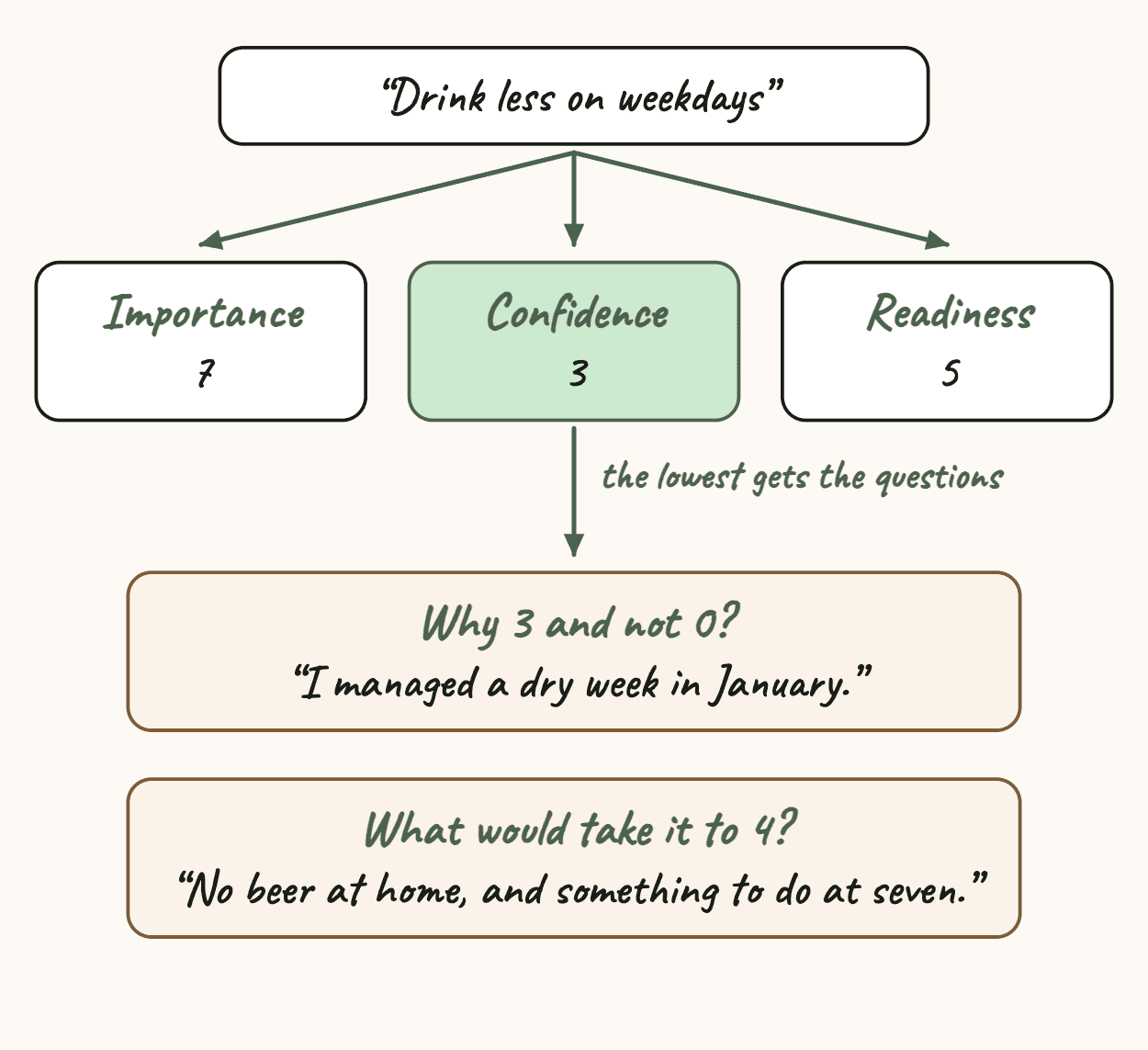
"Why 3 and not 0?" Dan thinks for a moment. "I managed a dry week in January." "What would take it to 4?" "No beer at home, and something to do at seven." Neither answer came from anyone else. They are his.
Change talk
What Dan said is what MI calls change talk: anything a person says in favor of change. It comes in kinds: a wish ("I want my mornings back"), an ability ("I did a dry week before"), a reason ("I'd save money"), a need, a commitment ("I'll try Monday to Thursday"), and steps taken ("I didn't buy beer this week"). Talk in favor of staying the same is called sustain talk. Both are normal parts of ambivalence.
MI listens for change talk and asks for more. In a study of people seeking help for drug use, how strongly they voiced commitment to change during the session predicted whether they stayed abstinent. A meta-analysis of the MI process linked a higher share of change talk to less risky behavior later.
Pros and cons, and why MI uses them carefully
Writing down pros and cons is older than MI. Irving Janis and Leon Mann described this decisional balance in their 1977 theory of decision making. For a habit it means four boxes: the good and not-so-good things about staying as you are, and about changing.
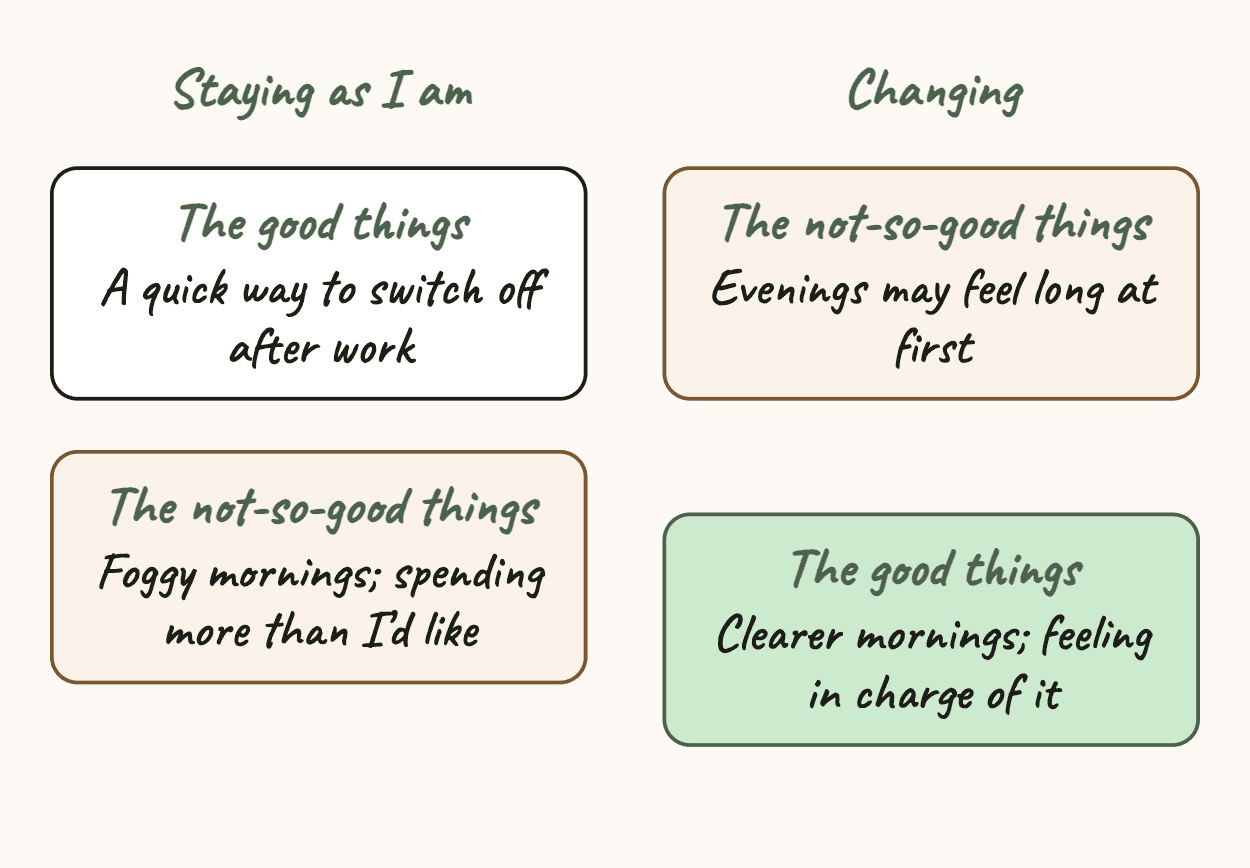
It is honest to write the good side of staying as you are; Dan's beers really do help him switch off. But Miller and Gary Rose, reviewing the research, drew a useful distinction. Weighing both sides evenly suits a helper who wants to stay neutral, for example between two reasonable options. For a person with mixed feelings, an even list of reasons to stay as they are can lower commitment to change, while drawing out change talk tends to strengthen it. For someone who has already decided, a balance sheet may firm up the decision.
So the pros and cons are a place for honesty, not the whole method. In CopingCard the four boxes come in a fixed order, staying first and changing last, so the list ends on the good things about changing.
Stages of change and the URICA
The stages of change are not yet considering a change (precontemplation), thinking about it (contemplation), getting ready (preparation), doing it (action) and keeping it going (maintenance). The model comes from James Prochaska and Carlo DiClemente; it is separate from MI, though the two grew up side by side. It is a rough map, not a set of boxes: people often move back and forth before a change holds, and slipping back is part of how change usually goes.
The University of Rhode Island Change Assessment (URICA) is a short questionnaire about how ready you are to change. Developed by McConnaughy, Prochaska and Velicer in 1983 for people starting psychotherapy, it measures four of the stages with 32 statements such as "I have a problem and I really think I should work at it." It gives a readiness score: contemplation plus action plus maintenance, minus precontemplation. It asks about change in general, not one change, so CopingCard shows your latest URICA beside every change, with the date and the words "about change in general".
From reasons to a plan
When change talk turns into commitment, it is time to plan. Two weeks later Dan rates again: importance 7, confidence 5, readiness 6. His plan: no beer Monday to Thursday. Steps: leave beer out of the Sunday shop; a walk after work on Mondays and Wednesdays at seven. Who can help: a colleague who cut down last year. If a hard day gets in the way, he will make tea and walk anyway. He will know it is working by three clear mornings a week. To see first what a habit does for you, read Functional Analysis.
Had he decided not to change, that would be a real answer too. MI respects the person's choice.
Step by step in CopingCard
- Write down the change. In the Tools tab, open Motivational interviewing. Tap A change I'm thinking about, put it in your own words under The change, and if you like, tap the values it serves under What it matters for (optional). The wind rose is another way to find them. Up to three changes can be open at a time.
- Rate it. On the change's page, tap Rate it. Choose 0 to 10 for Importance, Confidence and Readiness. The app asks the two questions about your lowest ruler above 0; tap another under Questions about: to answer about that one. Your answers to "why not 0?" collect under My reasons, in my words, and each rating adds a line to The rulers over time.
- Write the pros and cons. Tap Pros and cons and write in the four boxes, one item per line.
- Note change talk. When you notice a reason, a wish or a step you took, tap Note change talk, and if you like mark it, such as Something I want or A step I took.
- Make a plan when you are ready. Tap Change plan. Under each step, Add to my homework puts it on your Homework list, where it can have a day, repeat and remind you.
- See where you are. If you have not taken the URICA (a short questionnaire about how ready you are to change) yet, the change's page offers How ready am I for change? (URICA questionnaire); after you take it, your stage of change shows on every change.
- Close it, or not. Close this change with Done, Decided not to or Other. It stays in your history, and Reopen brings it back.
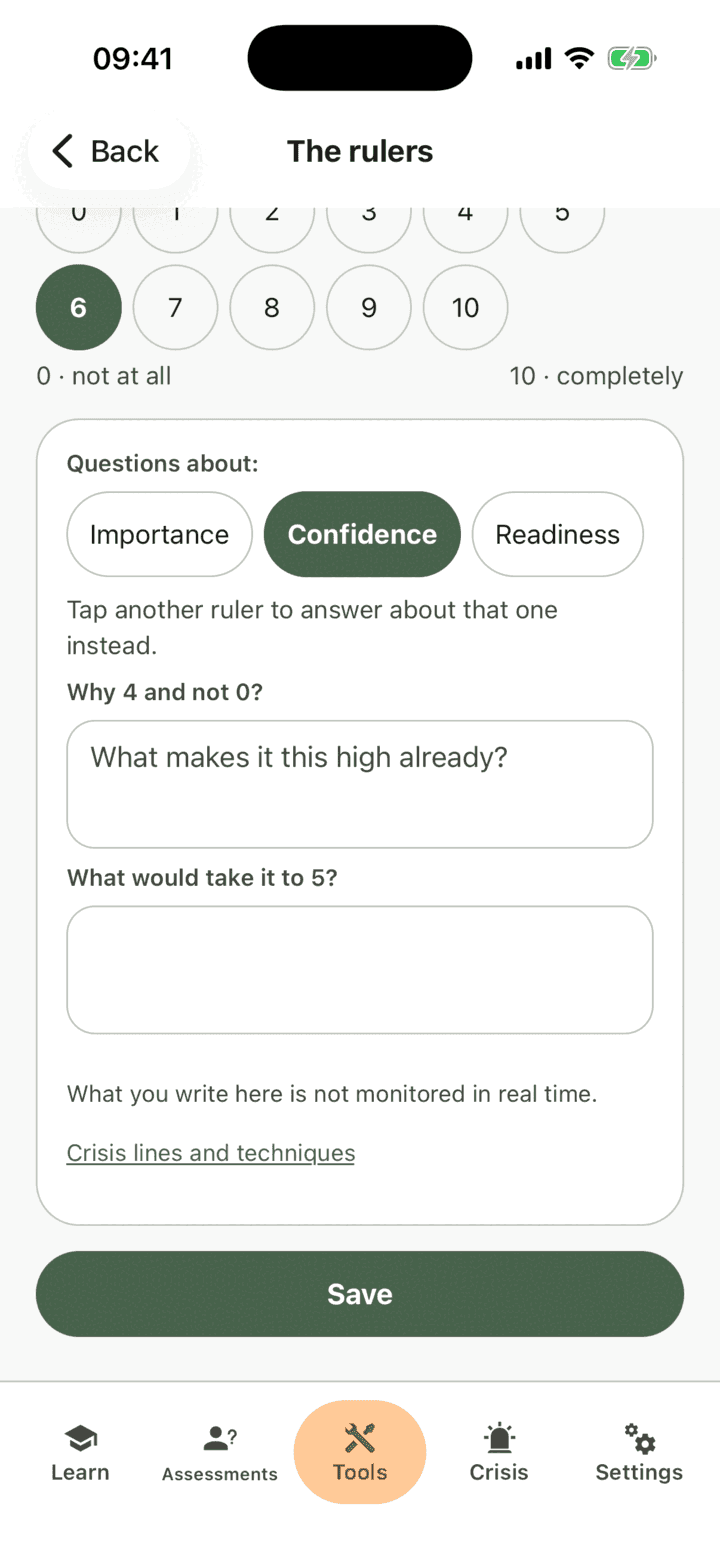
The app shows your numbers and words back to you; it does not judge, score or advise. Paper can hold a ruler and a list too. It does not ask the two questions at the right moment, keep every rating over weeks, carry a step into your homework, or show it all to your therapist before you meet. For the screens step by step, see the Motivational interviewing page in the help center.
With a therapist
If you allow your therapist to view your data, they see your changes on your page in their portal, under Skills & exercises, Motivational interviewing: the rulers over time (the ruler the questions were about in bold), your answers in your words, your change talk, pros and cons, plan and stage from the URICA (the readiness-to-change questionnaire). They are not alerted when you write. See Choose what your therapist can see.
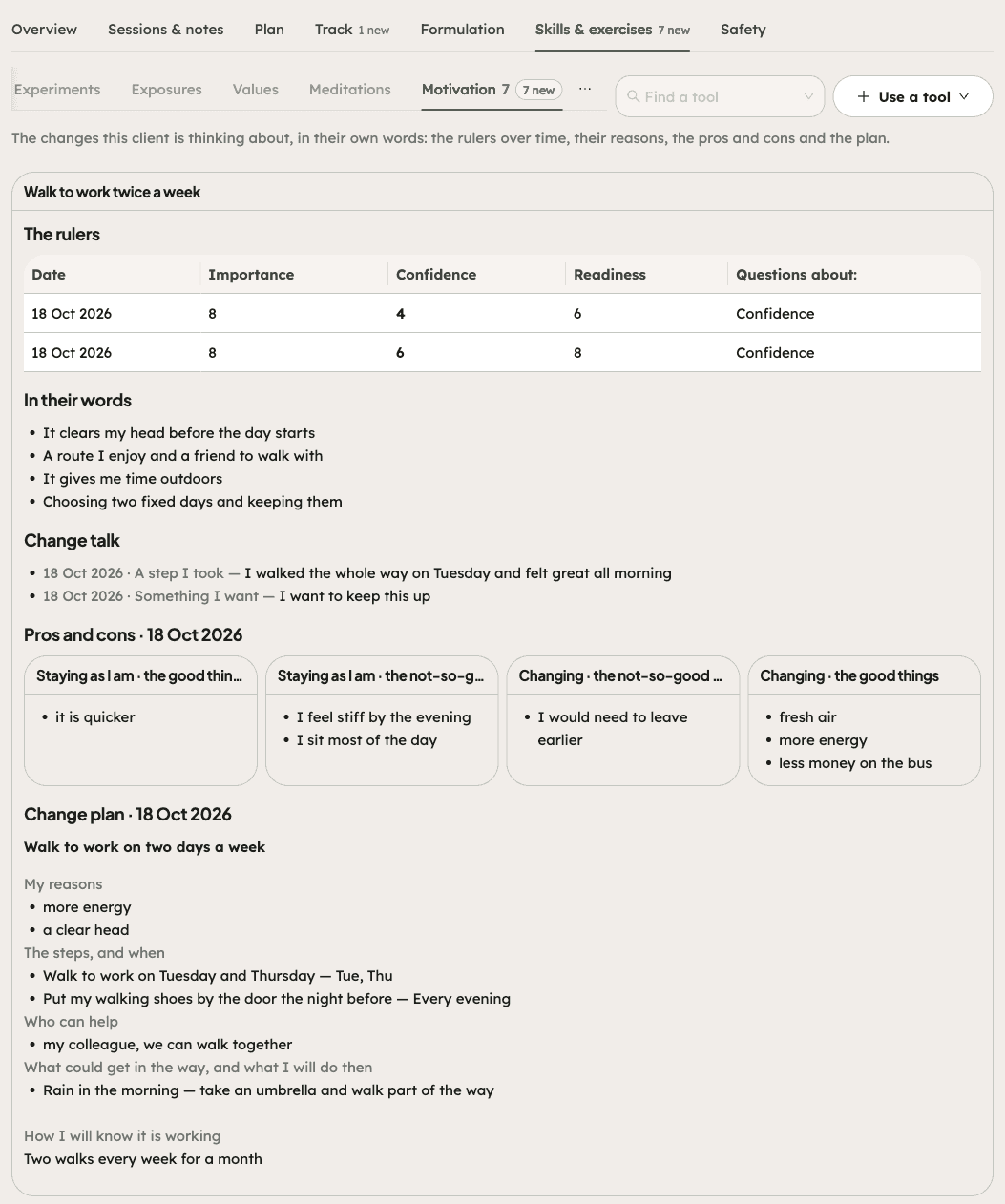
Before Dan's session, his therapist, Anna, reads that his confidence moved from 3 to 5. She can start by asking what helped. A therapist can also write a change down with you in session, in your words, and it appears in Motivational interviewing on your phone. And she can ask for The three rulers, Pros and cons or A change plan before the next session. It arrives as homework and is marked done when you save that record in the app.
What the research says
A meta-analysis of 119 studies found that MI had small but lasting effects on drinking, drug use, smoking, gambling and health habits such as diet and exercise, compared with no treatment or written information. A review of over a hundred reviews found the clearest benefits for drinking, substance use and physical activity. MI also helps people engage with other treatment, as in the anxiety trial above, and research on how it works keeps pointing to the person's own change talk.
When to get more help
Thinking about a change can bring up shame about a habit or worry about failing. That is understandable, and a therapist can help. If your body has come to depend on alcohol, for example you drink every day and wake up shaky, sweaty or anxious, do not stop suddenly on your own: stopping overnight can be harmful, so talk to a doctor first. If you feel unsafe at any point, open the Crisis tab in the app, or contact your local emergency services. For other ways to build a change, see low mood and getting active and solving a problem step by step.
In short
- Mixed feelings about a change are normal.
- MI draws out your own reasons, in your words, and leaves the choice with you. It is a way of talking, not a trick.
- The rulers and the questions "why not 0?" and "what would take it one higher?" bring out your reasons.
- Pros and cons are a place for honesty; MI uses them with care.
- In CopingCard you rate, reflect, plan and note change talk, and your therapist can read it before you meet.
Sources
- Miller, W. R., & Rollnick, S. (2023). Motivational Interviewing: Helping People Change and Grow (4th ed.). Guilford Press.
- Miller, W. R. (1983). Motivational interviewing with problem drinkers. Behavioural Psychotherapy, 11, 147-172.
- Rollnick, S., & Miller, W. R. (1995). What is motivational interviewing? Behavioural and Cognitive Psychotherapy, 23(4), 325-334.
- Miller, W. R., & Rollnick, S. (2009). Ten things that motivational interviewing is not. Behavioural and Cognitive Psychotherapy, 37(2), 129-140.
- Miller, W. R., Benefield, R. G., & Tonigan, J. S. (1993). Enhancing motivation for change in problem drinking: A controlled comparison of two therapist styles. Journal of Consulting and Clinical Psychology, 61(3), 455-461.
- Miller, W. R., & Rose, G. S. (2015). Motivational interviewing and decisional balance: Contrasting responses to client ambivalence. Behavioural and Cognitive Psychotherapy, 43(2), 129-141.
- Janis, I. L., & Mann, L. (1977). Decision Making: A Psychological Analysis of Conflict, Choice, and Commitment. Free Press.
- Amrhein, P. C., Miller, W. R., Yahne, C. E., Palmer, M., & Fulcher, L. (2003). Client commitment language during motivational interviewing predicts drug use outcomes. Journal of Consulting and Clinical Psychology, 71(5), 862-878.
- Magill, M., Apodaca, T. R., Borsari, B., Gaume, J., Hoadley, A., Gordon, R. E. F., Tonigan, J. S., & Moyers, T. (2018). A meta-analysis of motivational interviewing process: Technical, relational, and conditional process models of change. Journal of Consulting and Clinical Psychology, 86(2), 140-157.
- McConnaughy, E. A., Prochaska, J. O., & Velicer, W. F. (1983). Stages of change in psychotherapy: Measurement and sample profiles. Psychotherapy: Theory, Research & Practice, 20(3), 368-375.
- Prochaska, J. O., DiClemente, C. C., & Norcross, J. C. (1992). In search of how people change: Applications to addictive behaviors. American Psychologist, 47(9), 1102-1114.
- Westra, H. A., Arkowitz, H., & Dozois, D. J. A. (2009). Adding a motivational interviewing pretreatment to cognitive behavioral therapy for generalized anxiety disorder: A preliminary randomized controlled trial. Journal of Anxiety Disorders, 23(8), 1106-1117.
- Lundahl, B. W., Kunz, C., Brownell, C., Tollefson, D., & Burke, B. L. (2010). A meta-analysis of motivational interviewing: Twenty-five years of empirical studies. Research on Social Work Practice, 20(2), 137-160.
- Frost, H., Campbell, P., Maxwell, M., O'Carroll, R. E., Dombrowski, S. U., Williams, B., Cheyne, H., Coles, E., & Pollock, A. (2018). Effectiveness of motivational interviewing on adult behaviour change in health and social care settings: A systematic review of reviews. PLoS ONE, 13(10), e0204890.