The Wind Rose: Comparing Ways of Living
Maya is good at her job and everyone at work can rely on her. She answers messages at ten at night, says yes to most requests and eats lunch at her desk. When she thinks about what she wants from life, she says "more balance". That is a fair wish, but hard to act on: what would she actually do differently on Tuesday?
The Wind rose makes that question concrete. It is a technique by Dr. Dmitri Dyakov, a Belarusian cognitive behavioral therapy (CBT) researcher and trainer. You describe a way of living, rate how well it meets eight basic emotional needs, and see the result drawn as a shape. Then you do the same for another way and compare the two. This article explains the idea and the steps in CopingCard.
A way of living is more than a word
When people are asked what they value, they often answer with a word: family, health, success. The Wind rose starts from a different idea. A value shows up as behavior: a pattern of things you keep doing, held up by beliefs about why it matters and by people who share it.
So the unit of the exercise is a way of living: a name, plus the concrete things you do in it. Maya's current way, which she calls "Work first", is made of long hours, evening replies, desk lunches and few days off. Everyone lives some way, named or not, and it usually has reasons: "Work first" gives Maya security and competence.
This fits the wider CBT family. In acceptance and commitment therapy (ACT), part of the third wave, a value is a direction you act on. In behavioral activation, what you do day by day shapes how you feel. The Wind rose looks at the whole pattern of behavior and asks what it does for you.
The eight needs
In Dyakov's method the eight needs are:
- Nurturance and acceptance
- Empathy and understanding
- Stability and predictability
- Safety
- Competence
- Autonomy
- Freedom to express needs and emotions
- Spontaneity and play
The list draws on the basic emotional needs of schema therapy (Young and colleagues), another third-wave approach, and related models. The idea is that how well we feel over time depends on how well these needs are met, and that this depends heavily on what we do. These are not exact measures; they are eight questions that let you look at your life from different sides.
Step 1: Describe the way you live now
Start with the way you actually live, not the way you think you should. Give it a name that sounds like you ("Work first") and write what you do in it. Be concrete: "reply to messages until bedtime", not "overwork".
Step 2: Rate it on the eight needs
Close your eyes and picture living this way. For each need, give a number from 1 to 10. A 1 means this way gives you almost none of that need, and a 10 means plenty. Rate the way over time, not one good or bad day, and add an example if one comes to mind.
Here are Maya's ratings for "Work first".
| Need | Rating |
|---|---|
| Nurturance and acceptance | 4 |
| Empathy and understanding | 3 |
| Stability and predictability | 5 |
| Safety | 10 |
| Competence | 10 |
| Autonomy | 5 |
| Freedom to express needs and emotions | 3 |
| Spontaneity and play | 4 |
Notice that a 9 or 10 is not treated as better than an 8: the ring on the rose is at 8 and means "enough". Dyakov's view is that an adult does not need every need met to the maximum, and that pouring effort into one need, such as safety, can cost the others. So the mean is calculated with any score above 8 counted as 8. Maya's mean of the scores is 5.5, and her mean capped at 8 is 5.0. The app shows both numbers.
Step 3: See the rose
The ratings are drawn as a shape on eight rays, one ray for each need, with the ring at 8. You read it in two ways.
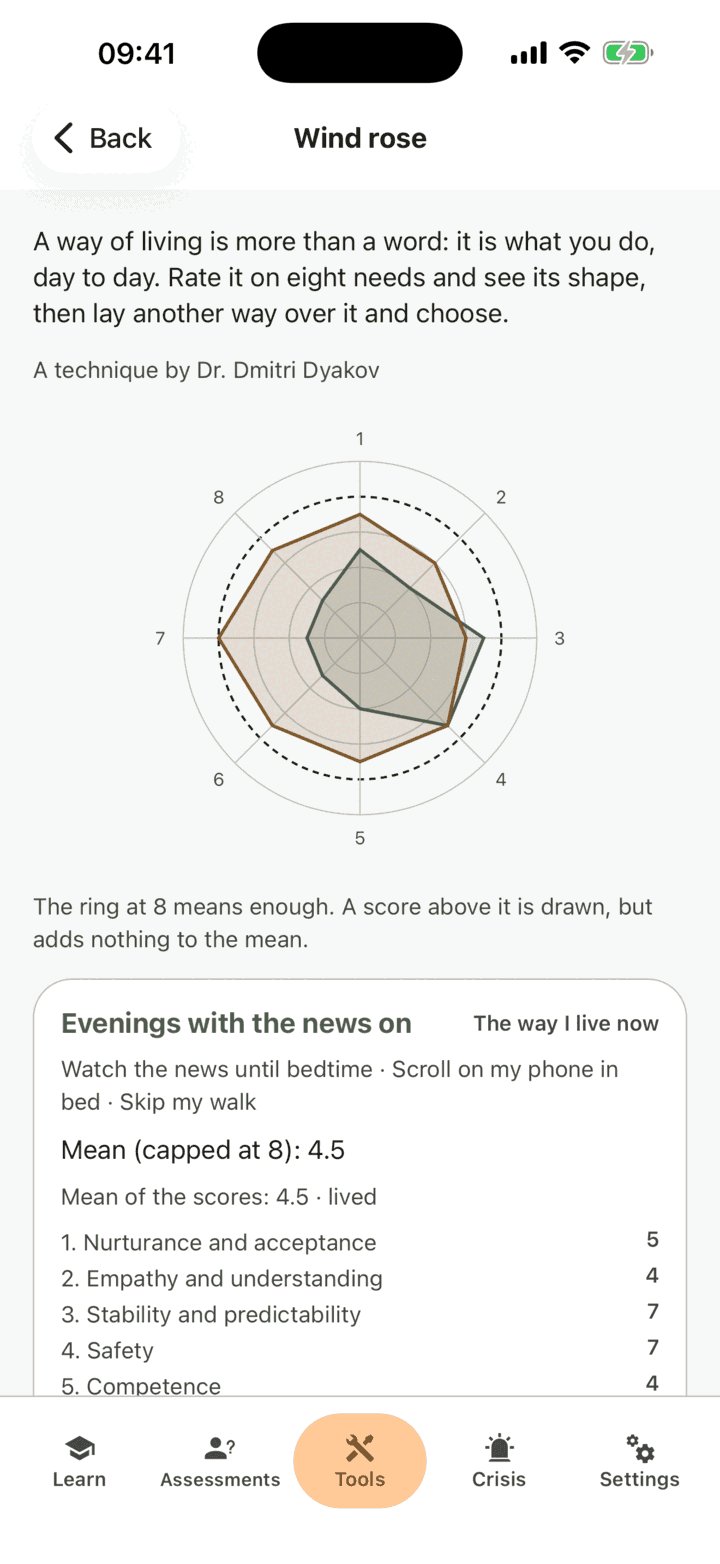
By size. A larger rose means the way meets your needs better overall.
By shape. A lopsided rose shows that a way of living serves some needs well and starves others. Maya's "Work first" bulges toward safety and competence and is pulled in at self-expression.
The shape is not a verdict. It is a map of what a way of living gives you and what it costs. Maya did not conclude that she was doing something wrong. Her way did what she built it for, and she could now see what it left out.
Step 4: Describe another way
Now you build a second way, and the rule is the same: it is made of behavior, not outcomes. "Be less stressed" is an outcome. "Leave work at six on Tuesdays and Thursdays" is something you can do. A way needs at least one concrete thing you would do, and up to ten.
Ideas can come from your own past, someone close to you, someone you admire from a distance, a book or film, or your card sort. In CopingCard you can note where the idea came from.
Maya called her second way "Make room": finishing work at six on two days, a Thursday pottery group and a Saturday run with a colleague. She rated it the same way. Because she had not lived it yet, its rating is marked imagined, and the first is marked lived. An imagined rating is a guess; a lived one is evidence.
She gave "Make room" 8 for safety, 7 for competence, 8 for autonomy and 8 for self-expression, with 6 or 7 for the rest. Laid over the first rose, it is rounder. Its mean is 7.0 against 5.0 for "Work first": a little less safety and competence, and much more of the rest. You can make a third way, or a fourth.
Step 5: Try them on and choose
A choice made only on numbers can feel flat, so the exercise asks you to try each way on. Close your eyes and picture living it for a week: what you do, who is with you, how your body feels. Stay with each for about a minute. Nothing is saved from this step.
Then you choose. You name the value the way stands for, in your own words. Maya wrote "Be present in my own life". You also write the beliefs that hold it up from inside ("Rest makes my work better, not worse") and the people who share it, who hold it up from outside. A way with both is easier to keep than one that depends on willpower alone. Choosing is not a promise forever: you can rate the chosen way again later.
Step 6: Plan it
A choice that stops at a choice tends to fade, so the last step is a plan with three horizons: this week, this month and this year. For each step you write what it is, who is with you and what it needs.
Maya's week had one step: tell her team she finishes at six on Tuesday and Thursday. Her month had the pottery group, and her year a long weekend away with no laptop. She started with the smallest step, this week.
What the app adds to pen and paper
You can do this exercise on a sheet of paper with eight spokes drawn on it. The app helps with the parts that are easy to lose.
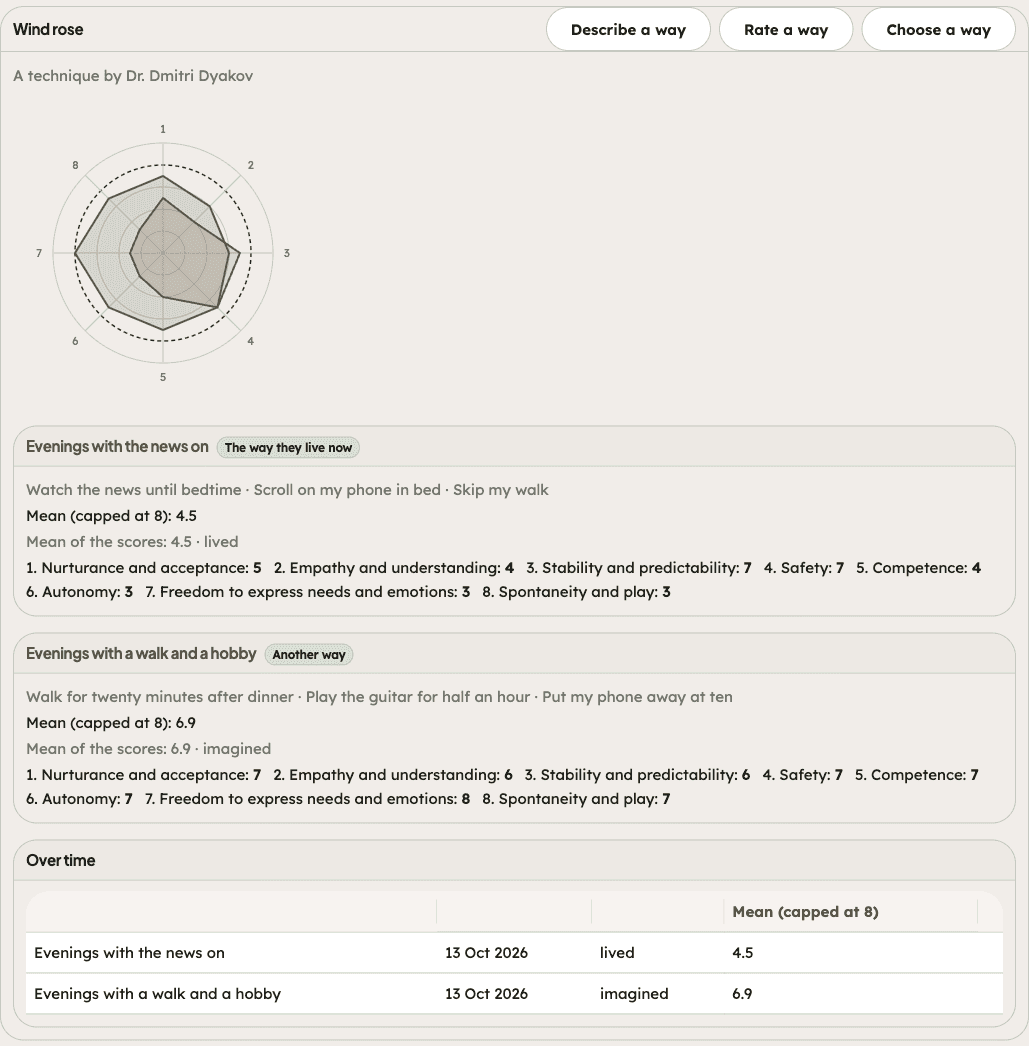
- The rose is drawn for you. You enter eight numbers and get the shape, the ring at 8, and both means. Several ways are drawn together on the same rose.
- Lived and imagined are kept apart. Each rating is marked as one or the other.
- Ratings are kept over time. Rate your chosen way again after a few weeks and the earlier ratings stay, so you can see whether the way you chose pays off.
- The chosen way joins your values. It appears on My values, in the Values tool, as a value with its rose line.
- The plan turns into action. A step for this week can be added to your activities in Behavioral Activation, with a difficulty from 1 to 10. You can plan the first step, ask someone to help, or turn a belief that holds your way up into a coping card linked to your value.
- Your therapist can see it, if you let them. If you share your data, your therapist can read your wind rose in the portal, and can describe, rate and choose with you in a session. Anything they enter is marked as entered in session. They can also assign the exercise, and it counts as done when you choose a way.
Who sees it
Your wind rose is yours. A therapist you are connected to can read it only if you switch on Allow viewing my data for them. The admins of their practice can read it only if Allow practice admins to view my data is on. Your therapist is not alerted when you rate or choose. You can change the options at any time: see Choose what your therapist can see.
Where the ideas come from
The Wind rose is a structured exercise from Dyakov's clinical practice and teaching. It brings together ideas used across CBT: values work in ACT and behavioral activation, rating areas of life and drawing the result, and the emotional needs of schema therapy. It helps you think about how you live and prepare for a conversation with your therapist.
Using it with your therapist
The exercise was made for therapy. A therapist can ask for the example behind a low rating, or help you think about what will keep the second way going. If you do it alone, take your rose to a session and start with what surprised you.
When to get more help
Looking closely at your life can bring up strong feelings, such as sadness about what is missing. That is understandable. If the feelings are heavy or last for days, talk to your therapist or your doctor. If you feel unsafe at any point, open the Crisis tab in the app, or contact your local emergency services.
In short
- A way of living is a name plus the things you do, not a word.
- The rose shows how well it meets eight needs, by size and by shape. A rating above 8 counts as 8 in the mean.
- Build another way from concrete behavior, rate it, and try both on before you choose.
- A choice needs a plan: this week, this month, this year.
- It is a structured exercise from Dyakov's clinical practice, made for thinking about your life and talking it through with your therapist.
For the step-by-step guide to the screens, see the Wind rose page in the help centre. To find the values behind your choice, see What Matters to You: Finding Your Values.
Sources
- Dyakov, D. G. «Роза ветров человеческого поведения» (The wind rose of human behavior). Taught in his courses and clinical training.
- Young, J. E., Klosko, J. S., & Weishaar, M. E. (2003). Schema Therapy: A Practitioner's Guide. Guilford Press.
- Hayes, S. C., Strosahl, K. D., & Wilson, K. G. (2011). Acceptance and Commitment Therapy (2nd ed.). Guilford Press.
- Martell, C. R., Addis, M. E., & Jacobson, N. S. (2001). Depression in Context. W. W. Norton.