Planning for Hard Moments: Your Safety Plan
Some moments are much harder than others. When one arrives, it is not easy to think clearly, to remember what has helped before, or to find a phone number. A safety plan is something you write beforehand, while you feel steady, so that the next step is already there when you need it.
This article explains what a safety plan is, what goes into it, and how to make one in CopingCard. It is calm, practical and short on purpose. If you are having a hard time right now, you do not have to read it through. Open the Crisis tab, or contact someone you trust, or your local emergency number.
What is a safety plan?
A safety plan is a short, written list of steps you can follow when a hard time starts. It is personal: it uses your own words, your own warning signs and your own people. The steps go from the ones you can do alone to the ones that involve other people, and finally to professional help. You read it from the top and stop at the first step that helps.
The structure comes from the Safety Planning Intervention, developed by Barbara Stanley and Gregory Brown and used by clinicians in many settings. In one study of veterans seen in emergency departments, those who made a safety plan with a clinician and got follow-up calls had fewer suicidal behaviors afterward than those who got usual care. CopingCard's plan follows the same steps, adds a seventh part for reasons for living, and uses its own wording.
A safety plan is not a promise to stay safe, and it is different from a "no-suicide contract": it is a practical list of steps that you write for yourself. It is also not a prediction that something will happen. Think of it like a fire exit plan: you hope you will never need it, and you are glad it is there.
Where it fits in suicide-specific care
The Safety Planning Intervention was designed as a brief, clinician-delivered session, with contact afterward. It is one part of care for people at risk, not the whole of it. Therapies built specifically for suicidal thoughts and behavior have their own evidence. Cognitive therapy for suicide prevention (Brown and colleagues, 2005) is a ten-session cognitive therapy for adults who had recently attempted suicide, and those who received it were less likely to make another attempt over the following 18 months than those who received usual care. Brief CBT for suicide prevention (Rudd and colleagues, 2015) showed a similar result in active-duty soldiers. The Collaborative Assessment and Management of Suicidality (CAMS) is a structured, suicide-focused way of working, and dialectical behavior therapy (DBT) is used for people with repeated self-harm. A safety plan sits beside these and often starts them. If you have thoughts of ending your life, please also talk to a therapist or a doctor. A safety plan helps you through a hard moment; therapy can do much more.
Why the surroundings part matters
The part on making your surroundings safer can feel awkward, so it helps to know why it is there. A suicidal crisis is often brief. In one study of people who had made an attempt, nearly half said that ten minutes or less passed between the first thought of it and the act. Distance between a person and anything that could be used to cause harm buys time for the intensity to pass, and reviews of means restriction find that it saves lives, since many people do not switch to another method. This is why the plan asks you to think about it with your therapist, and why it matters even when it feels uncomfortable.
Best made with a therapist or someone you trust
You can start your plan on your own, and many people do. But it works best when it is made together with your therapist, or with someone you trust. They can help you think of steps you might not come up with alone, and of people you might not think to include. Some parts are especially good to do together, such as making your surroundings safer.
If you work with a therapist in CopingCard and you have allowed them to edit your records, they can add to the plan with you. Their additions are marked as added by your therapist. You can always see what is in your plan, and you can change it.
The seven parts
The plan in CopingCard has seven parts. You can fill them in at your own pace and come back to add more.
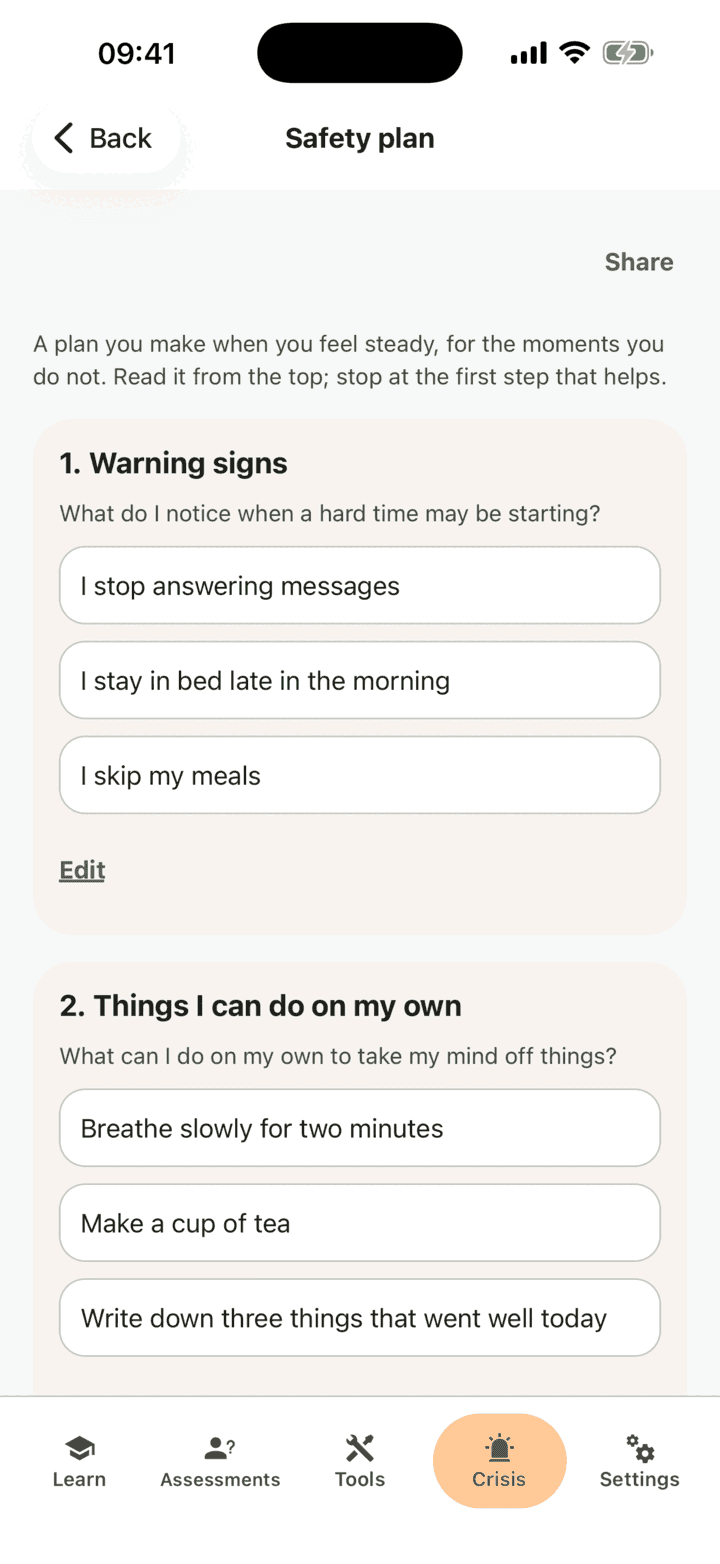
- Warning signs. What do you notice when a hard time may be starting? Thoughts, moods, situations or things in your body. For example: "I stop answering messages."
- Things I can do on my own. What helps you take your mind off things? For example: cold water on your face, or a walk around the block.
- People and places that help me feel steadier. Where can you go, or who can you be around? A friend's kitchen, a café, a park, a place of worship.
- People I can ask for help. Whom can you tell that you are having a hard time? Add a name and a number, or choose someone from your contacts.
- Professionals and crisis lines. Your therapist, your doctor, and the crisis lines the app shows.
- Making my surroundings safer. What can you do to make your space safer? This one is best done with your therapist.
- My reasons for living. What matters most to you? People, pets, plans, things you want to see or do.
Each part holds up to ten entries. Short and specific is better than long. "Call Sam, 7 p.m. is usually good" is more useful than "talk to someone."
What the app adds to a paper plan
A paper plan has the same steps. What can go wrong is simpler: it is in a drawer, or at home, when the hard moment comes. The Safety Planning Intervention is built around a written list that a person can use in a crisis (Stanley and Brown, 2012), so having the list within reach matters as much as having written it.
- Within reach, and offline. The plan is kept on your phone. You find it in the first row of the Crisis tab and in the Toolkit, and you can read it without a connection.
- A home-screen widget with a plain name. A "My plan" widget opens the plan in one tap. You can rename it in the app, and nothing on it says safety, crisis or anything else about its purpose, so it is private on a shared screen.
- Call and Message. Each person has a Call button and a Message button, and the message is already written: "I'm having a hard time — can you call me?"
- Contacts. You can choose a person from your contacts, and only the one you choose is read. On Android, the first time, your phone asks you to allow access to contacts.
- With your therapist. If you have allowed your therapist to edit your records, they can add to the plan with you, and their additions are marked as added by your therapist. They can also record when the plan was last reviewed and when the next review is due, and see the history of changes.
- Your privacy. Your therapist sees how many times a week you open the plan. They cannot see when, or what you read, and you are told that they can.
- Linked from the diary card. If you use a diary card, its daily form carries a link to your plan.
These are practical features: the aim is that the plan you wrote is the one within reach when you need it.
Making yours, step by step
- Choose a calm time. Not in the middle of a hard moment. A quiet evening, or a session with your therapist.
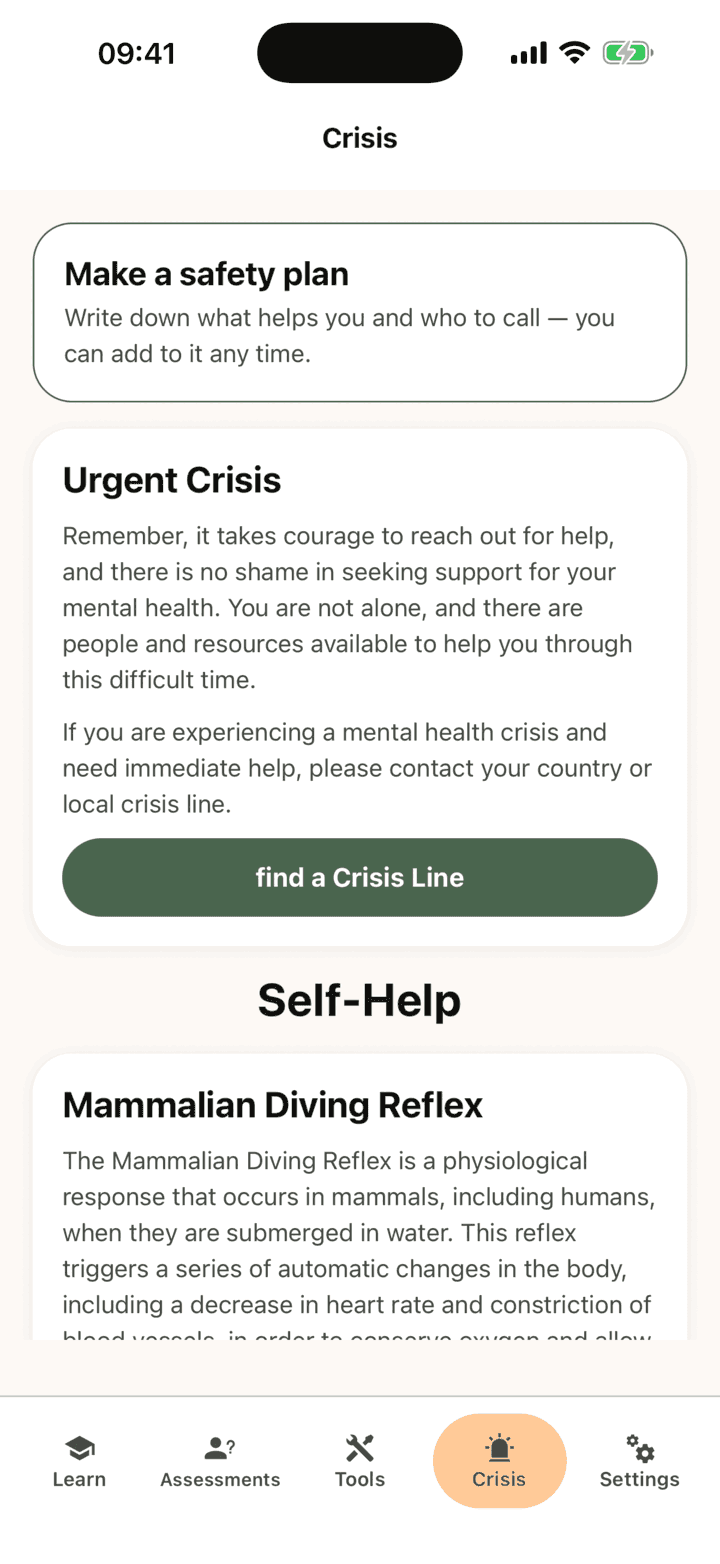
- Open the plan. Go to the Crisis tab and tap the first row, My safety plan, or find it in the Toolkit.
- Start where it is easiest. Many people begin with the things that help them. You do not need to go in order.
- Use your own words. Write it as you would say it.
- Add real people. Add a number so that the Call button works (you can pick the person from your contacts). Ask the person first if you can, so they are not surprised.
- Check it with someone. Read it with your therapist or a trusted person. Does it sound like you? Is anything missing?
- Review it now and then. After a hard stretch, or when things change, such as a new phone number or a new job.
Using the plan
When a hard time starts, open the plan and read it from the top. Stop at the first step that helps. Each contact has a Call button and a Message button, and the message is pre-written for you, such as "I'm having a hard time — can you call me?", so you do not have to find the words.
The plan is stored on your phone, so you can read it even when you are offline. You can find it in the Crisis tab and in the Toolkit.
On privacy: your therapist can see how many times a week you open the plan. They cannot see when, or what you read, and nothing is sent to them when you open it.
When the plan is not enough
A plan is a help, not a replacement for people. If you cannot keep yourself safe, or you are in immediate danger, contact your local emergency number right away (112 works in many countries). The Crisis tab shows crisis lines for your language, and in the US you can also call or text 988. You can also go to the nearest emergency department or ask someone to stay with you.
If you are not working with anyone yet and you find these moments come more than once, consider this a good reason to start. A therapist can help you with both the plan and the things that make the hard times hard.
Related: People, support and asking for help and Staying well.
In short
- Make the plan while you feel steady, in your own words.
- Seven short parts, read from the top, stopping at the first step that helps.
- Best made with your therapist or someone you trust.
- Keep it current, and put real names and numbers in.
- Open it from the Crisis tab whenever you need it.
Sources
The structure of the plan is based on the Safety Planning Intervention.
- Stanley B, Brown GK. Safety Planning Intervention: a brief intervention to mitigate suicide risk. Cognitive and Behavioral Practice. 2012;19(2):256-264. (Cited for the written, prioritized list of coping strategies and sources of support to use in a crisis.)
- Stanley B, Brown GK, Brenner LA, et al. Comparison of the Safety Planning Intervention with follow-up vs usual care of suicidal patients treated in the emergency department. JAMA Psychiatry. 2018;75(9):894-900.
- Brown GK, Ten Have T, Henriques GR, et al. Cognitive therapy for the prevention of suicide attempts: a randomized controlled trial. JAMA. 2005;294(5):563-570.
- Rudd MD, Bryan CJ, Wertenberger EG, et al. Brief cognitive-behavioral therapy effects on post-treatment suicide attempts in a military sample. American Journal of Psychiatry. 2015;172(5):441-449.
- Deisenhammer EA, Ing CM, Strauss R, et al. The duration of the suicidal process. Journal of Clinical Psychiatry. 2009;70(1):19-24.
- Yip PSF, Caine E, Yousuf S, et al. Means restriction for suicide prevention. The Lancet. 2012;379(9834):2393-2399.
- Jobes DA. Managing Suicidal Risk: A Collaborative Approach. 3rd ed. Guilford Press; 2023.